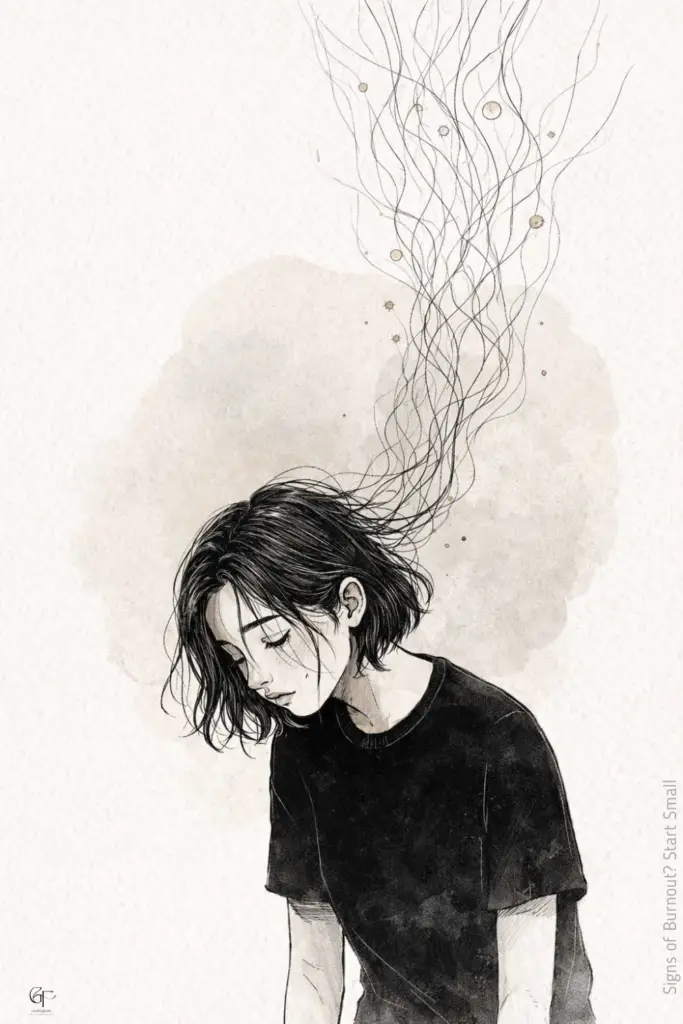
There’s a strange thing about burnout. It doesn’t show up when you’ve already collapsed. It doesn’t announce itself loudly when everything falls apart. It creeps in much earlier — when you’re still functioning, still delivering, still getting things done. Just not quite the same way you used to.
For a long time, I explained it away. “It’s a heavy week.” “I just need the weekend.” “Everyone feels like this sometimes.” But the signs of burnout didn’t disappear. They just got quieter — and more persistent.
The World Health Organization classifies burnout as an occupational phenomenon defined by three dimensions: chronic exhaustion, growing mental distance from your work, and reduced professional effectiveness. These don’t appear overnight. They build slowly. And that’s exactly what makes them dangerous.
What follows isn’t a diagnosis. It’s a mirror. If more than a few of these signs of burnout feel familiar, it might be worth pausing for a moment.
The 10 Signs of Burnout to Watch For
1. You’re Not Just Tired — You’re Depleted
One of the earliest signs of burnout is a specific kind of fatigue that rest simply doesn’t fix.
Tiredness goes away with rest. A good night’s sleep, a quiet weekend, and you feel like yourself again.
Depletion doesn’t. You wake up already running on less. It’s not always dramatic — more like a constant low-level deficit. As if you’re perpetually starting from a minus. You stop expecting to feel refreshed, because you stopped remembering what that actually felt like.
This is one of the most reliable early signs of burnout, and it’s the one most people brush off the longest — precisely because it’s so easy to explain away.

2. Things That Used to Excite You Now Just Feel Like Tasks
It’s not that you suddenly hate everything. It’s subtler than that.
The work you once found genuinely interesting is now just a checklist. You do it because you have to — not because you want to. The curiosity or energy that used to come naturally has quietly disappeared.
This gradual loss of motivation is one of the signs of burnout that sneaks up on you. It often happens so slowly that you barely notice until one day you realize you can’t remember the last time something at work actually felt meaningful.
3. You’ve Become More Cynical Than Usual
This one is easy to rationalize, but it’s one of the most telling signs of burnout.
A bit more eye-rolling. A growing sense of “what’s the point?” A creeping distance from the people around you and the things you’re doing.
Cynicism is often a defense mechanism — a way to emotionally detach from something that has become too much. The problem is, it also cuts you off from what used to give things meaning. And once that disconnection takes hold, it’s hard to shake.
4. Your Performance Is Slipping — And You Know It
Not always visibly. But you feel it.
It’s harder to concentrate. Simple tasks take longer than they should. You make mistakes you wouldn’t have made before. You procrastinate more, not because you’re lazy, but because starting anything feels like lifting something heavy.
And perhaps the most frustrating part: you don’t fully understand why. “This used to be easy.”
The answer is straightforward — there simply isn’t enough mental energy left. The tank isn’t full, and you’re running on fumes.
5. Sleep Isn’t Restoring You
Maybe you’re sleeping less. Or maybe you’re sleeping the same amount — but waking up exhausted anyway.
Trouble falling asleep. Waking in the middle of the night. That unsettling feeling that the sleep wasn’t deep, wasn’t real. You close your eyes for eight hours and open them still tired.
Research on burnout and sleep consistently shows that chronic stress disrupts both sleep quality and the body’s ability to recover during rest. Sleep is often the first system to break down — and the last to fully recover.

If you’re looking for gentle habits that help you sleep better, read my earlier article: 7 Soft Girl Evening Habits for Better Sleep.
6. Your Body Is Sending Signals Too
Signs of burnout are not only mental or emotional — they show up physically.
Headaches. Persistent muscle tension, especially in the neck and shoulders. Stomach issues. Getting sick more often than usual. Small, recurring symptoms that you keep treating as separate problems.
But often they’re part of the same story.
Your body is trying to communicate something your mind has been too busy to hear. When the load has been too heavy for too long, the body stops waiting for you to slow down and starts slowing you down itself.
7. You Feel Emotionally Flat
Not necessarily sad. Just… less.
Good things don’t excite you the way they used to. Difficult things don’t shake you the way they should. Everything feels slightly muted, slightly far away — as if you’re watching your own life through glass.
This is emotional exhaustion. A kind of protective numbness that sets in when the system has been running on overdrive for too long. It keeps you from feeling too much. But it also keeps you from feeling enough.
8. Small Things Are Setting You Off
Things that wouldn’t have bothered you before now do.
An email. A vague comment. A minor inconvenience — and suddenly the reaction is bigger than the situation warrants. You snap. You feel irritated for no clear reason. Afterward, you wonder why it hit so hard.
This isn’t a character flaw. It’s a signal that your nervous system is overloaded.
When there’s very little energy in reserve, there’s also very little left for emotional regulation. The buffer disappears, and reactions that would normally be filtered through become much more raw.

9. You Keep Getting Sick
This is the sign of burnout that most people treat as completely unrelated to everything else.
“I just have a weak immune system.” “I keep catching what’s going around.”
But behind it, there’s often the same root cause: sustained stress and depletion.
Studies show that chronic psychological stress suppresses immune function, making the body more vulnerable to illness. When you’re running on empty for extended periods, maintaining those defenses becomes harder. It’s not bad luck — it’s biology.
10. You’ve Lost the Sense of Why
This might be the hardest sign of burnout to sit with.
Not just tired. Not just overwhelmed. But beginning to question whether what you’re doing even matters anymore.
This isn’t necessarily a philosophical crisis. It’s more like a quiet, persistent question that keeps surfacing in the background:
“Why am I doing this at all?”
And when there’s no answer — or when the answer you once had no longer feels true — that absence accelerates everything else. It hollows out the effort. It makes the exhaustion heavier.

Why Ignoring the Signs of Burnout Is Risky
Because they rarely resolve on their own.
In fact, they tend to deepen. The exhaustion becomes more profound. The cynicism becomes harder to shake. The performance drop becomes more visible — to you, and eventually to the people around you.
And at some point, you’re no longer talking about subtle signs of burnout. You’re talking about not being able to keep going the same way at all.
That’s the point everyone wants to avoid. The problem is, most people only recognize it after they’ve already crossed it.
The Hard Truth About Burnout
For a long time, I thought recognizing signs of burnout in myself meant I wasn’t strong enough. That I couldn’t handle the pace. That I should have done better.
Now I see it differently: burnout is often a sign that you held on too long.
Too long saying yes when you meant no. Too long pushing past your own limits. Too long treating your own needs as the last item on the list.
And eventually, the system does what any overloaded system does: it shuts down.
What to Do When You Recognize These Signs of Burnout
You don’t need to change everything at once. Trying to overhaul your entire life immediately usually doesn’t work — and often adds more pressure to an already full load.
But one thing is worth taking seriously: if several of these signs of burnout feel true right now, that’s not coincidence. That’s a pattern. And every pattern points to something that isn’t working.
You can start small:
- Track your depletion. Notice when you feel most drained — and what typically comes right before it.
- Identify your biggest energy drain. One consistent source is usually doing more damage than several smaller ones.
- Choose one adjustment. Not ten. One. Something specific and manageable.
- Set a boundary you’ve been avoiding. One conversation, one “no,” one task you stop taking on.
It doesn’t sound revolutionary. But small, consistent changes tend to work better than dramatic overhauls that last three days before collapsing under their own weight.
If you’re looking for a structured way to start understanding your patterns, journaling can be a surprisingly effective tool — our guide to journaling prompts for self-discovery is a good place to start.
Summary: Know the Signs of Burnout Before It Knows You
The 10 signs of burnout covered in this article:
- Chronic depletion that rest doesn’t fix
- Loss of motivation and engagement
- Growing cynicism and emotional detachment
- Declining performance and concentration
- Sleep that doesn’t restore
- Physical symptoms — headaches, tension, frequent illness
- Emotional flatness and numbness
- Disproportionate irritability
- Suppressed immune response
- Loss of meaning and purpose
Burnout doesn’t happen overnight. And it doesn’t resolve overnight either. But there’s something important buried inside it: it’s information. It’s telling you that something has been out of balance for longer than you’ve been willing to admit.
If you catch these signs of burnout early — before the collapse, not after — you don’t just get to recover. You get the chance to build something more sustainable on the other side.
If what you’re experiencing goes beyond fatigue — if this feels heavy in a way that’s affecting your daily life — please don’t navigate it alone. Speaking to a therapist or doctor is not a sign of weakness. It’s one of the most practical things you can do. The American Psychological Association’s burnout resources are a good starting point.
Did this resonate? Save it, share it, or leave a comment below — sometimes the most useful thing you can do for someone is send them an article at the right moment.