If you’ve ever finished a perfectly color-coded to-do list and still felt completely empty, you already know that time management alone can’t fix everything. You can master every productivity hack out there and still feel drained, foggy, and one step from burnout. That’s because the real issue usually isn’t your schedule — it’s your energy management. Once you understand the difference, the whole game changes.

My Burnout Wake-Up Call
Two years ago, I lived by a color-coded calendar and a to-do list broken down to the minute. I was proud of how “productive” I looked on paper. And that’s exactly when I burned out the hardest.
The turning point came when I realized I wasn’t falling behind because I scheduled my time badly. I was falling behind because I kept trying to do my hardest work at the exact moments I had nothing left to give. My time was accounted for. My energy wasn’t.
That’s the moment I stopped asking “how do I fit more in?” and started asking “when do I actually have the capacity for this?” It changed everything about how I plan my days — and it’s the whole reason this post exists.
Energy Management vs Time Management: What’s the Real Difference?
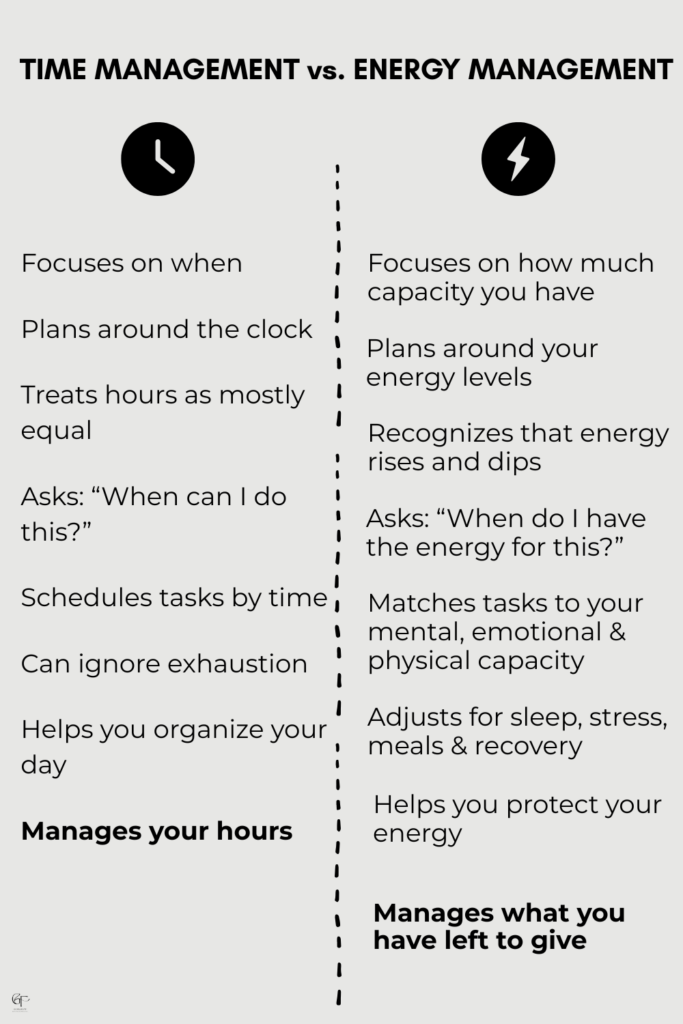
Time management is about the clock: blocking hours, setting deadlines, deciding what gets done when. It treats every hour as roughly equal, as long as it’s scheduled well.
Energy management is different. It’s about paying attention to your mental, emotional, and physical capacity, and matching your tasks to the energy you actually have — not the energy you wish you had. It covers more than just physical stamina — your emotional and mental energy count too, which is why it can feel so much more personal and intuitive than a rigid schedule.
Here’s the simplest way I explain it to myself: time is fixed. You get the same 24 hours as everyone else, no matter what. Energy is variable — it rises, dips, and depends on sleep, stress, meals, and how much you’ve already given that day. When you plan only around the clock and ignore the dips, you end up scheduling important, hard tasks for moments when your brain has nothing left to offer.
That mismatch — good time management, poor energy awareness — is usually where burnout quietly starts.
It’s worth saying plainly: this isn’t about being lazy or undisciplined. Plenty of people with excellent time management skills still burn out, because a perfectly organized calendar says nothing about whether the person filling it in has anything left to give. Energy management is the missing layer that actually protects you.
Why Time Management Alone Can’t Give You Productivity Without Burnout
Traditional time management assumes that if you block the hours right, the output will follow. But anyone who has pushed through a task at 9pm on fumes knows that’s not how humans actually work.
Real productivity without burnout depends on when you do something, not just whether it’s on the calendar. Doing your most demanding work during a natural energy dip means it takes longer, feels harder, and drains you more than it should. You get the task done, technically. But you pay for it later with exhaustion, brain fog, or a short temper you don’t recognize as yourself.
This is also where a lot of high-functioning burnout hides. From the outside, your calendar looks full and organized. On the inside, you’re running on fumes because nothing in your schedule accounts for how depleted you actually feel.
Time management isn’t the enemy here — it’s just incomplete on its own. It needs energy awareness layered on top of it to actually protect you from burning out.
Think about the last time you tried to write something important, answer a hard email, or make a big decision right after a draining meeting. The task was on your calendar at a reasonable time. It just wasn’t the right time for your brain. Multiply that mismatch across a week, and it’s easy to see why a full schedule can still leave you feeling like you never actually got anything done — that’s the gap real productivity without burnout has to close.

How to Start Practicing Energy Management Today
You don’t need a new app or a total life overhaul to start. Small, consistent noticing is enough to begin shifting how you plan your days.
Map your energy peaks and dips. For a few days, jot down a quick note every couple of hours: energized, okay, or depleted. Most people notice a pattern fairly quickly — maybe a strong window mid-morning, and a slump after lunch, which lines up with how our circadian rhythm naturally shapes energy levels throughout the day. This is your personal energy map, and it’s more useful than any generic productivity schedule.
Match your hardest tasks to your highest-energy windows. Once you know your peaks, protect them fiercely for the work that actually needs your full brain — writing, decisions, problem-solving. Save your lower-energy windows for admin, email, or anything that doesn’t require deep focus.
Build in real recovery, not just breaks. A five-minute scrolling break doesn’t restore your energy in the same way that stepping outside, stretching, or sitting quietly can. A real break should leave you feeling more restored, not just temporarily distracted. This is the same principle behind a gentler approach to getting things done.
Notice your emotional energy, not just your physical energy. Some tasks — a hard conversation, a big decision, an emotionally loaded email — cost more than others, even if they take five minutes. Give yourself permission to treat emotional energy as a real, finite resource, the same way you’d treat sleep or caffeine.
Let journaling reveal your patterns. A simple nightly check-in — what drained me, what energized me — builds the kind of self-awareness that no planner app can give you.
Watch for silent energy leaks. Not every energy drain is obvious. Notifications you answer the second they arrive, decisions you keep re-deciding, or a cluttered workspace can quietly chip away at your energy long before a big task even starts. Closing a few of these small leaks often does more for your energy levels than any single productivity hack.

Can Time Management and Energy Management Work Together?
Yes — and honestly, they work best together. Time management gives you structure. Energy management tells you what to put inside that structure, and when.
Think of it less as a competition and more as time management with a layer of self-awareness added on top. You still use a calendar. You still set deadlines. But instead of filling every block the same way, you start assigning your hardest, most important work to the hours when you’re naturally sharpest — and protecting your lowest-energy hours for lighter tasks or rest.
This shift is subtle, but it’s the difference between a schedule that looks productive and one that actually feels sustainable. If burnout has been a recurring pattern for you, this might be worth pairing with a broader reset.
For a deeper, research-backed look at how workplace stress builds when energy and workload stay mismatched, the American Psychological Association’s overview of workplace burnout is worth a read — it’s a good reminder that this isn’t just a personal failing, it’s a pattern seen across entire workplaces. Mayo Clinic’s guide to job burnout also breaks down the warning signs clearly if you want to check where you stand.
Quick Recap: Energy Management Tips to Start Today
- Track your energy in simple check-ins for a few days to find your natural peaks and dips
- Match your hardest, most important work to your highest-energy windows
- Save low-energy windows for admin, email, or lighter tasks
- Build in real recovery — not just a scroll break
- Treat emotional energy as a real resource, not an afterthought
- Use time management for structure, and energy management to decide what goes where
- Revisit your energy map every few weeks — it shifts with seasons, stress, and sleep
FAQ
What’s the actual difference between time management and energy management? Time management focuses on scheduling and deadlines — how you divide up the hours you have. Energy management focuses on your mental, physical, and emotional capacity, and matching tasks to the times you actually have the energy for them.
How do I manage my energy instead of my time? Start by noticing your natural energy peaks and dips over a few days, then schedule your most demanding work during your highest-energy windows and lighter tasks during your dips. Recovery breaks matter just as much as the schedule itself.
What are some energy management strategies I can start with? Simple energy check-ins, matching tasks to your energy levels, protecting real recovery time, and paying attention to emotional energy (not just physical energy) are all approachable starting points.
How do I figure out my energy peaks and dips during the day? A short daily log — noting whether you feel energized, okay, or depleted every couple of hours — usually reveals a pattern within just a few days, without needing any special tools.
Can time management and energy management work together? Yes. Time management provides the structure of a schedule, while energy management helps you decide which tasks go into which time slots based on your actual capacity, making the whole system more sustainable.

Conclusion
Time management can only take you so far if it ignores how much you actually have to give on any given day. Energy management fills that gap — it’s what turns a full calendar into a sustainable one. You don’t need to abandon your planner. You just need to start listening to your energy as closely as you watch the clock.
Your Tourn
If this reframed how you think about your schedule, save this post to Pinterest so you can come back to it next time your calendar feels impossible — and tell me in the comments: what time of day is your energy actually at its best?