If someone stopped you right now and asked, “What emotions do you feel the most?” — could you actually answer? Not the textbook list of happy, sad, angry, scared, but the real, specific, this‑week version that becomes clearer when you use a body map template.
For most of us, the honest answer is somewhere between “I don’t know” and “a lot, all the time, all mixed together.” That foggy non-answer is exactly the gap a body map template for emotions is designed to fill. Instead of starting with words, you start with a simple outline of a human body and a few colored pencils, and you mark where each feeling actually shows up — the tightness in your chest, the heat in your face, the heaviness in your shoulders.
It sounds almost too simple to work. But this little practice has quietly become one of the most clarifying tools in my own journaling routine, and it’s the reason I finally created a printable version to share with you.
Why I Started Mapping My Feelings Instead of Naming Them
A few years ago, my therapist asked me a version of that opening question — what was I feeling, right then, in the room. I froze. I genuinely had no word for it. What I could tell her was that my throat felt tight, my stomach was doing something uncomfortable, and my hands were cold even though the room was warm.
She said something I never forgot: “That’s not nothing. That’s data.” She asked me to sketch a rough outline of a body on a notepad and shade in where I felt those sensations. The second I did that, the word arrived almost on its own — it was dread, not sadness, and definitely not the generic “stress” I’d been calling it for months.
That session is the seed of this article. I started keeping a body map template for emotions in my journal, sometimes daily, sometimes only on the harder days, and over months a pattern emerged that no amount of “just sit and think about your feelings” had ever shown me.
What surprised me most wasn’t any single map — it was looking back at a month’s worth of them side by side. I could see that my “Sunday evening dread” always landed in the exact same spot, low in my stomach, every single week, long before I consciously registered that the new week was coming. Words had never caught that pattern on their own. A handful of quick body sketches did, almost immediately.
The Science: Where Emotions Actually Live in the Body
This isn’t just a cozy journaling trend — there’s real research behind it. One of the most cited studies on this topic, published in the Proceedings of the National Academy of Sciences, asked over 700 participants across several countries to color body silhouettes to show where they felt sensations increase or decrease during different emotional states. The researchers found that body mapping has become a powerful method for capturing how emotion is experienced in the body, offering a direct, introspective way to see how people locate and represent feelings physically. Even more interesting, distinct emotions like anger, fear, sadness, disgust, happiness, and surprise produce noticeably different and fairly consistent patterns of bodily activation across people.
In plain terms: anger and fear tend to light up the chest, arms, and head. Sadness often shows up as a draining or heaviness in the limbs. Disgust clusters around the stomach and throat. None of this is random — it’s a fairly universal map your nervous system has been drawing your whole life, whether or not you’ve ever looked at it on paper.
This lines up with what the American Psychological Association describes as emotion’s defining feature — it’s never just a thought, it’s a full reaction pattern that includes physical sensation alongside feeling. A body map template for emotions simply gives that physical layer a visible, trackable form instead of letting it stay vague background noise.
It also connects to something therapists who work with anxiety see constantly: many people can describe their physical symptoms (racing heart, shallow breathing, a knot in the stomach) far more easily than they can name the underlying emotion. The National Institute of Mental Health notes that anxiety symptoms can interfere with daily life in ways that go well beyond occasional worry, which is part of why learning to read your own body’s signals early — before the spiral starts — can be such a useful skill.

How to Use the Free Body Map Template — Step by Step
Here’s exactly how I use my own body map template for emotions, broken down so you can start tonight if you want to.
1. Pick a moment, not a perfect time. You don’t need silence or a sunrise. Use the template right after a hard conversation, a wave of anxiety, or even a strangely good moment you can’t quite explain.
2. Close your eyes for ten seconds before you draw anything. Scan from your head down to your feet. Don’t analyze — just notice. Where is there tension, heat, heaviness, tingling, or numbness? This is essentially a mini body scan, a technique that blends breath focus with progressive muscle relaxation and can boost your awareness of the mind-body connection — Harvard Health’s guide to relaxation techniques covers a longer version if you want to go deeper.
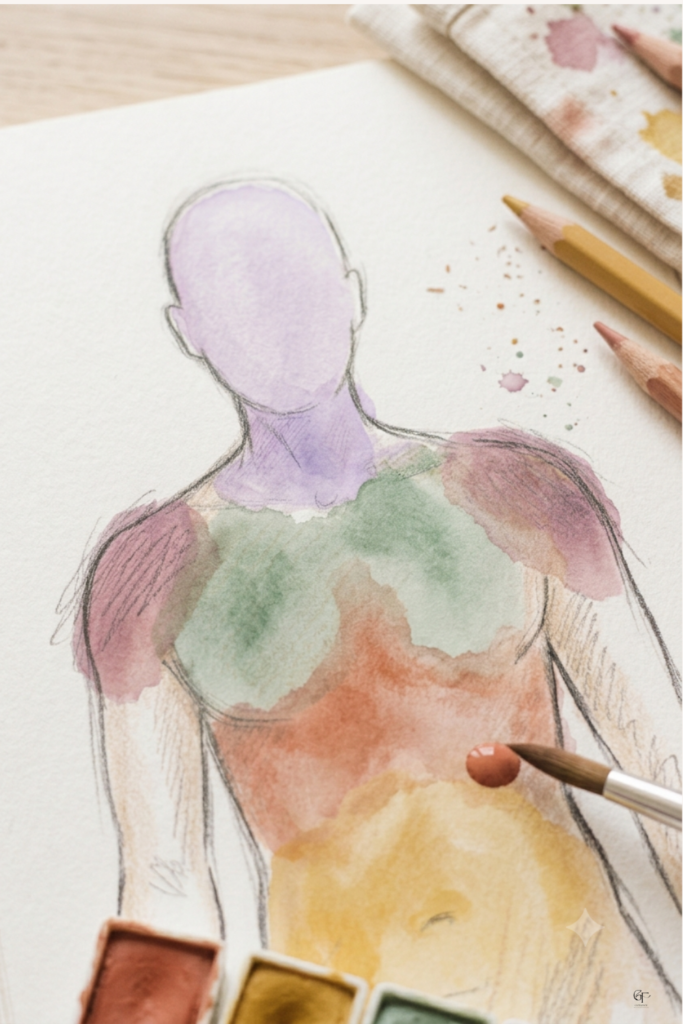
3. Mark it on the body map, no editing. Use color, shading, arrows, scribbles — whatever feels honest. Tight shoulders might get a dark scribble. A fluttery stomach might get small dots. There’s no wrong way to fill out a body map template for emotions; the visual is just a translator, not a test.
4. Now try to name it — and write the sentence. With the sensations already on paper, ask: if this feeling had a name, what would it be? Write one sentence underneath the drawing: “My chest is tight and my breathing is shallow — I think this is anxiety about tomorrow’s meeting, not just generic stress.” Naming the emotion after you’ve located it in the body tends to feel far less forced than trying to name it cold.
5. Add one small action, if you have the energy. Not a fix, just a response — a few slow breaths, a glass of water, stepping outside for two minutes, or simply writing “I noticed this, that’s enough for today.”
6. Keep the pages. This is where the real value of a body map template for emotions shows up — not in one single map, but in a stack of them over weeks. You’ll start to see your own signature patterns: maybe anxiety always sits in your throat, while sadness pools in your legs. That pattern recognition is something no single journaling session can give you, and it’s often the most useful part of the whole practice — more useful, honestly, than any single “aha” moment. If old emotional patterns keep surfacing, the prompts in 20 Deep Reparenting Journaling Prompts for Inner Child Healing can help you trace them further back.
Quick Recap
- A body map template for emotions helps you locate feelings in the body before trying to name them in words.
- Research shows different emotions tend to create distinct, fairly consistent patterns of physical sensation across people.
- The practice works well right after an emotional moment — no need to wait for a calm, quiet time.
- A short body scan, then drawing, then naming, then one small action: that’s the whole sequence.
- Saving your filled-out maps over time reveals your own personal patterns — where you tend to “hold” specific emotions.
- This is a supportive self-awareness tool, not a diagnostic one; for anxiety that feels overwhelming or constant, it’s worth talking to a professional alongside your journaling practice.
Final Thoughts
What emotions do you feel the most? You may not have a clean answer yet — and that’s completely fine. The point of a body map template for emotions isn’t to arrive at a perfect label every time. It’s to build a habit of pausing, checking in with your body, and treating those physical sensations as useful information instead of background static to push through.
Over time, this small habit does something words alone rarely manage: it teaches you to catch a feeling earlier, while it’s still a flicker in your shoulders or stomach, long before it becomes a flood you have to recover from.
Get Your Free Printable
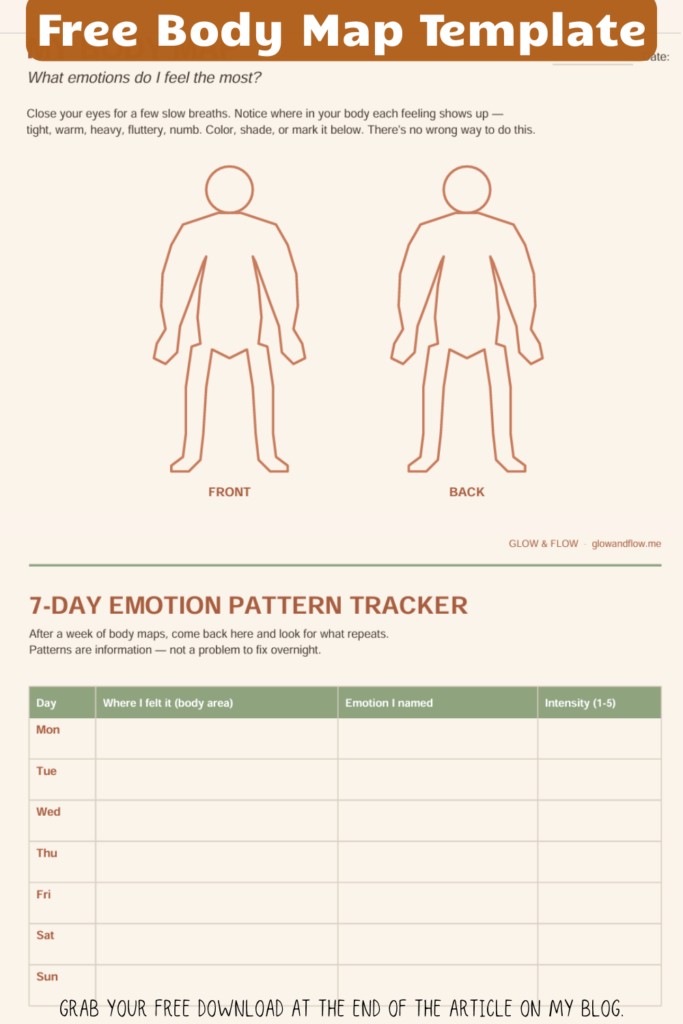
The printable body map PDF includes a fine‑line front‑and‑back body outline that you can freely color, mark, or annotate. Next to the body contours, there is a one‑sentence emotion note section, where you can briefly describe what emotion you felt in your body on that particular day.
The PDF also features a 7‑day emotion pattern tracker, designed to help you notice where recurring tensions or emotions tend to appear and how they shift throughout the week. The template offers a clean, easy‑to‑use tool for tracking bodily sensations and emotional patterns — without needing to draw your own body outline from scratch.
👉 Download your free body map template for emotions here: [Free Printable: Body Map Template]