There’s a specific kind of ache that shows up when you least expect it — a sharp word from a friend that ruins your whole week, a silence that feels like rejection, a small mistake that makes you spiral into shame. If you’ve ever wondered why your reactions feel bigger than the moment calls for, you’re not broken. You’re carrying a younger version of yourself who never got the comfort she needed, and reparenting journaling prompts are one of the gentlest ways to finally give her that comfort now.

My Story: Why I Started Reparenting Myself
A few years ago, I noticed I apologized for things that weren’t my fault — for taking up space, for having needs, for simply existing inconveniently. I traced it back to a childhood where love often came with conditions. Nobody sat down and harmed me on purpose, but the steady absence of comfort taught me that my feelings were too much. Writing became the place where I finally let that younger self speak. Slowly, page by page, I learned to answer her instead of silencing her. That’s the heart of reparenting, and it’s why I built this list of reparenting journaling prompts — not as a tidy exercise, but as a real act of care.
What Is Reparenting, Really?
Reparenting is the process of consciously offering yourself the safety, validation, and structure that may have been missing in childhood. It doesn’t mean blaming your parents or rewriting history. It means becoming the steady, compassionate presence your inner child needed, using the wisdom and resources you have now as an adult.
Mental health researchers describe the “inner child” concept as a useful therapeutic metaphor for the emotional patterns, beliefs, and unmet needs formed early in life — patterns that often resurface in adult relationships and self-talk. According to the American Psychological Association, early attachment experiences shape how people regulate emotion and form relationships well into adulthood. Reparenting journaling gives you a structured, private way to interrupt those old patterns and respond differently this time.

How to Use These Prompts
Before you dive in, a few gentle ground rules:
- Find a quiet, uninterrupted 10–20 minutes. This work deserves your full attention, not a rushed five minutes between tasks.
- Write by hand if you can. Slower writing tends to access deeper, more honest emotion.
- Use your non-dominant hand for some prompts. Many trauma-informed therapists suggest this technique because it can bypass the analytical adult brain and connect more directly to younger, more vulnerable emotional states.
- Don’t edit yourself. There is no wrong answer here — only your truth.
- Pace yourself. You don’t need to do all 20 in one sitting. Even one prompt a day is meaningful progress.
20 Reparenting Journaling Prompts for Inner Child Healing
Prompts for Safety and Comfort
1. What did young you need to hear during your scariest childhood moment, and can you say it to her now? Choose one clear childhood moment and picture it vividly. Then write the simple, comforting words that child needed to hear. This helps you connect directly to the unmet need for safety.
2. Describe a place where your inner child would feel completely safe. What does it look, sound, and smell like? Let yourself be sensory and specific rather than abstract — instead of “somewhere peaceful,” try the exact texture of a blanket or the sound outside a window. Building a sensory “safe place” gives your nervous system somewhere real to return to during moments of anxiety.
3. What does comfort look like to you now, and who taught you that comfort wasn’t allowed? Answer the two halves separately. First describe comfort in concrete, physical terms. Then trace back to a person, a sentence, or a household rule that made comfort feel undeserved. Tracing the origin of a belief is often the first step to gently dismantling it.
4. Write a letter to yourself as a child, signed “Love, Future You.” Write the way you’d speak to any frightened child in front of you, not the way adults spoke to you. Short sentences, warmth, no lectures. Let it be soft and reassuring above all else.
Prompts for Validation
5. What feeling did you have to hide growing up, and what would it feel like to express it freely today? Start with the feeling itself — anger, sadness, fear, even excitement — before analyzing why it had to be hidden. Notice what happens in your body as you imagine expressing it openly now.
6. List three things you were never told were okay to feel. Don’t overthink the list. Write the first three feelings that come to mind, even if they seem small or contradictory. The instinctive answer is usually the truest one.
7. If your younger self could see you now, what would she be proud of? Think in terms of what she actually wanted as a child — safety, freedom, being seen — rather than adult achievements like a job title. Pride from a child’s eyes looks different than pride from an adult’s.
8. What’s something you needed comfort for but were told to “get over”? Picture the actual sentence someone said to you, and notice how it still echoes in how you treat your own feelings today. This prompt often reveals a pattern you still repeat on yourself.

Prompts for Needs and Boundaries
9. What basic need went unmet most often in your childhood — safety, attention, affection, or freedom? Read through those four categories slowly and notice which one creates the strongest emotional reaction in your body, not just your mind. Naming the specific need helps you address it directly rather than feeling a vague, unnamed lack.
10. What boundary did you wish an adult had set for you? Think less about rules and more about protection — a boundary that would have stopped something from happening to you, or shielded you from too much responsibility too young.
11. Write down a “house rule” your inner child actually needed, even if it was never spoken. Imagine the rule on a kitchen wall in a kind, well-functioning home. What would it say? “It’s okay to ask for help” or “Feelings are allowed here” are good starting shapes.
12. What’s one need you can meet for yourself this week that nobody met for you back then? Keep it small and doable — a phone call, a nap without guilt, asking directly for support. The point is proof, not perfection: showing your inner child that the need can finally be met.
Prompts for Self-Compassion
13. If your inner child made a mistake today, what would you say to her? Picture an actual child you care about making that same mistake. Borrow the gentleness you’d naturally offer them, and notice the gap between that and how you usually speak to yourself.
14. What did you believe about your worth as a child, and is that belief still true? Write the childhood belief first, exactly as it was formed, even if it sounds harsh. Then, as the adult you are now, answer it honestly — does the evidence of your life actually support it?
15. Write a short apology to your inner child for any way you’ve dismissed her feelings as an adult. This isn’t about self-blame. Think of one or two recent moments you brushed past your own feelings, name them plainly, and apologize the way you would to a friend you’d accidentally hurt.
16. What would unconditional love from yourself look like in practice, today? Move from the abstract to the concrete — not “loving myself more,” but one actual behavior today, like resting without guilt or speaking to yourself more gently after a mistake.

Prompts for Play and Joy
17. What did you love doing before you learned to feel guilty about rest or play? Go back as far as you can, before productivity or achievement became part of the picture. Drawing, climbing trees, daydreaming — even the smallest detail counts.
18. If you gave your inner child one afternoon of pure joy, what would you do together? Design it like you’re planning a real outing for a child you love — specific activities, specific snacks, specific music. The more concrete, the more it can actually become a plan.
19. What’s a small, playful thing you can do this week purely because it makes you happy? HPick something with zero “usefulness” attached — not self-improvement, not exercise, not productivity. Pure enjoyment is the whole point of this one.
20. Write a letter from your inner child to you, telling you what she’s been waiting to say. Write with your non-dominant hand if you’re comfortable trying it, and let the language be simple and unfiltered. Don’t plan the content in advance — let it surprise you.
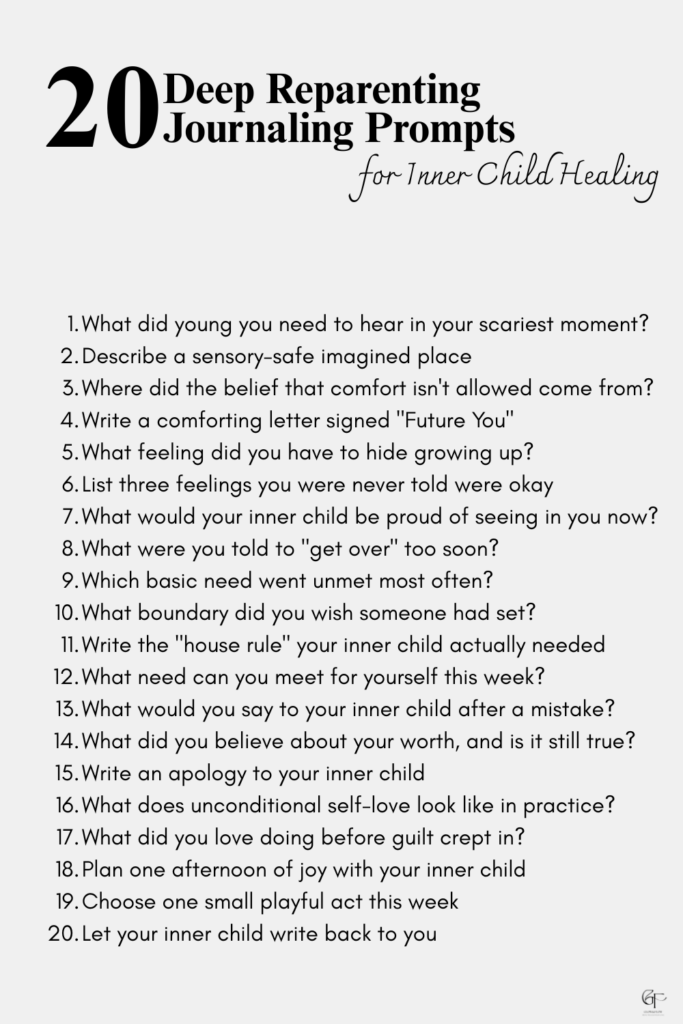
Quick Recap: All 20 Prompts at a Glance
Final Thoughts
Reparenting yourself isn’t about perfecting your past — it’s about meeting your present self with the steadiness you may not have received as a child. These reparenting journaling prompts aren’t a one-time fix; they’re a relationship you build with yourself, entry by entry, in your own handwriting and your own time. The National Institute of Mental Health notes that consistent self-reflective practices can meaningfully support emotional regulation over time, and journaling is one of the most accessible ways to build that consistency.
You don’t need to rush this. Some prompts will open something quickly; others might sit with you for weeks before they make sense. Both are valid. The goal isn’t to finish a list — it’s to keep showing up for the part of you that’s been waiting.
If you’re working through related themes, you might also find it helpful to revisit my post on recognizing childhood emotional neglect or my guide to 8 Science-Backed Anxiety Relief Methods Therapists Actually Use.
Your Turn
Which of these prompts hit the closest to home for you? I’d love to hear in the comments which one you’re going to try first — sometimes just naming it out loud (or in writing) is the beginning of real change. If this resonated with you, save it to Pinterest so you can come back to it whenever you need a gentle place to start, and subscribe so you don’t miss the next post in this healing series.