Your mind replays the same conversation for the tenth time. It jumps to worst-case scenarios before you’ve even had coffee. You lie awake rehearsing things you can’t control. If this sounds familiar, you already know how exhausting overthinking can be — and how hard it is to just “stop.” These 50 journal prompts for overthinking are here to help you slow the spiral down, one page at a time.

Why I Started Journaling to Quiet My Overthinking Mind
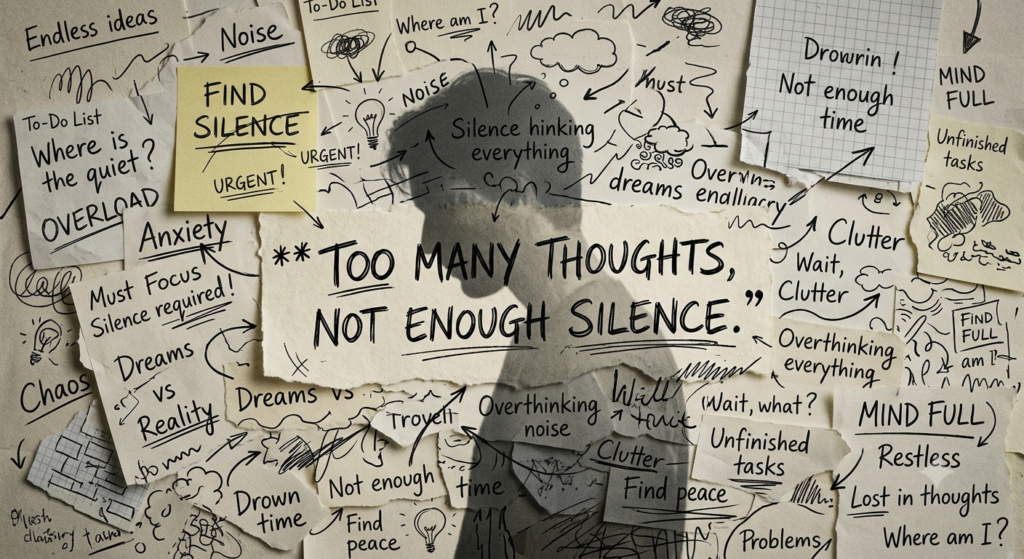
For years, my mind would replay conversations, imagine worst-case scenarios, and keep me awake long after everyone else had fallen asleep. I’d lie in bed rewriting texts I’d already sent, wondering if I’d said the wrong thing, bracing for problems that never actually happened.
Journaling didn’t fix everything overnight. But it became one of the few habits that helped me slow down, get my thoughts out of my head and onto paper, and separate real problems from anxious “what ifs.” Writing gave my thoughts somewhere to land instead of circling endlessly. That’s really what these prompts are for — not to overthink on paper, but to finally put the loop down.
Does Journaling Help With Overthinking?
Yes — journaling for overthinking works because it gives your anxious thoughts a container. When worries stay in your head, they tend to loop, exaggerate, and multiply. When you write them down, you slow the process enough to actually look at what you’re thinking, instead of just feeling swept up in it.
Putting a thought into words also forces your brain to organize it. A vague, circling fear (“something bad is going to happen”) becomes a specific sentence you can actually examine (“I’m worried the meeting went badly because my manager didn’t smile”). That shift alone often takes the edge off. It’s also why journaling is often recommended as a simple, accessible way to help manage anxiety symptoms alongside other coping tools.
What Should I Journal When You’re Overthinking?
When your mind is spiraling, the goal isn’t to write a perfect entry — it’s to get the thought out of your head. A few simple approaches:
- Name the loop. Write down the exact thought that keeps repeating.
- Separate fact from fear. List what you actually know versus what you’re imagining.
- Ask what you need. Comfort, reassurance, a plan, or simply rest.
The prompts below are organized by the kind of overthinking they’re best for, so you can jump to whichever moment you’re in right now.
50 Journal Prompts for Overthinking
Journal Prompts to Stop Late-Night Overthinking
Bedtime is prime overthinking territory. These prompts help quiet a racing mind before sleep.
- What thought keeps replaying tonight, and what would it look like written down instead of looped in my head?
- What am I afraid will happen if I stop thinking about this right now?
- What is one thing from today that I can let go of before I sleep?
- If I could send tonight’s worry a message, what would I want it to know?
- What is actually within my control about this situation, right now, at this hour?
- What would I tell a friend who was lying awake with this exact thought?
- What’s one sentence that sums up how I feel tonight, without judging it?
- What did I do well today that my anxious brain is skipping over?
- What is my body trying to tell me right now — tension, tiredness, restlessness?
- What’s one small, calming thing I can do in the next ten minutes?
Anxiety Journal Prompts for Worst-Case Scenarios
These anxiety journal prompts help you test the stories your mind is telling you.
- What is the worst-case scenario I’m imagining, written out in full?
- How likely is this outcome, realistically, on a scale of 1 to 10?
- What has actually happened in similar situations before?
- What would need to be true for the best-case outcome to happen instead?
- What evidence do I have for this fear, and what evidence contradicts it?
- If this worst case did happen, what would my very next step be?
- What part of this worry is really about control, not the actual outcome?
- Whose voice does this fear sound like — mine, or someone else’s from the past?
- What has this exact fear cost me in energy this week?
- What would I focus on instead if I trusted things would probably be fine?
Calm Mind Journal Prompts for Racing Thoughts
When thoughts are moving too fast to catch, these calm mind journal prompts slow things down.
- What are the three loudest thoughts in my head right now?
- If my thoughts were a weather pattern today, what would they look like?
- What is one thing that is true, calm, and steady right now?
- What would it feel like in my body if this thought simply softened?
- What’s one word that describes how I want to feel in the next hour?
- What is competing for my attention right now that isn’t actually urgent?
- If I only had energy for one thought today, which one deserves it?
- What sound, smell, or sensation around me right now can I focus on?
- What’s the difference between what I’m thinking and what is actually happening?
- What would “enough for today” look like, instead of “everything”?

Journal Prompts for Self-Compassion When You’re Anxious
Overthinking often comes with self-criticism. These prompts bring in some gentleness.
- What would I say to a friend who was being this hard on themselves?
- What is one thing I did today that deserves credit, even if it’s small?
- What part of me is trying to protect me by overthinking this?
- What do I need to hear right now that no one has said to me?
- Where did I learn that mistakes had to be catastrophic?
- What’s one way I can be gentler with myself in the next hour?
- What have I survived before that felt just as overwhelming as this?
- What would change if I treated this thought as information, not truth?
- What does my anxiety usually get wrong about how things turn out?
- What’s one boundary I could set to protect my peace this week?
Journaling for Overthinking at Work or in Relationships
Some of the most persistent spirals show up around people and performance.
- What conversation is replaying in my head, and what do I actually know about how it landed?
- What am I assuming the other person thinks, and is there evidence for that?
- What would I do differently if I believed people weren’t focused on me as much as I fear?
- What feedback am I giving myself that no one else has actually given me?
- What’s one thing I can clarify or ask about instead of guessing?
- What does “good enough” look like for this task or this relationship today?
- What’s the story I’m telling myself about what this means about me?
- What would I focus on if this interaction was already behind me?
- What’s one thing I’m proud of handling this week, even imperfectly?
- What would tomorrow-me want today-me to remember before reacting?

How to Use These Journal Prompts for Overthinking
You don’t need all 50 at once. A simple, sustainable approach to journaling for anxiety looks like this:
- Pick one prompt, not the whole list, each time you sit down to write.
- Set a timer for five to ten minutes so writing doesn’t become its own spiral.
- Write without editing — this isn’t for anyone else to read.
- Reread what you wrote once, then close the notebook. You don’t need to solve everything in one sitting.
Some people use these prompts at night, others first thing in the morning before the day’s noise starts. There’s no wrong time — only the time that actually helps you.
Quick Recap: Journal Prompts for Overthinking
- Journaling helps because it moves anxious thoughts out of your head and onto the page, where you can actually look at them.
- Use late-night prompts to quiet racing thoughts before sleep.
- Use worst-case-scenario prompts to test whether your fears match reality.
- Use self-compassion prompts when overthinking turns into self-criticism.
- Pick one prompt at a time, and give yourself permission to stop after ten minutes.

FAQ: Journal Prompts for Overthinking
What should I journal when I’m overthinking? Write down the exact thought that’s looping, then separate what you actually know from what you’re imagining. Naming the specific worry, instead of staying in a vague anxious feeling, is often the fastest way to calm down.
Does journaling help with overthinking? Yes. Journaling gives anxious thoughts a container instead of letting them circle endlessly in your mind. Putting a thought into words helps you examine it more clearly and often reduces its intensity.
What are good journal prompts for anxiety? The most helpful anxiety journal prompts ask you to name the worry, check it against evidence, and offer yourself some compassion. Prompts like “what’s the worst-case scenario, and how likely is it really?” work well because they gently challenge anxious thinking.
How do I stop overthinking everything? You likely won’t stop overthinking completely, and that’s okay — the goal is to interrupt the spiral sooner. Journaling, setting a timer for worry time, and asking “what’s actually in my control?” are small, repeatable ways to shorten the loop.
Can journaling calm an anxious mind? Journaling can absolutely help calm an anxious mind, especially when used consistently rather than only in moments of crisis. A randomized controlled trial published in the National Library of Medicine found that regular positive-affect journaling improved well-being and reduced distress in people with elevated anxiety symptoms. It won’t replace professional support if anxiety feels overwhelming, but as a daily practice, it builds a habit of slowing down before spiraling.

Final Thoughts
Overthinking can feel like it has a mind of its own — but it doesn’t have to run the show. These journal prompts for overthinking won’t erase anxious thoughts completely, but they give you somewhere to put them, and a little distance from the spiral. Some nights, that’s more than enough.
Your Next Step
Pick just one prompt from this list and try it tonight. If it helps, save this post to Pinterest so you always have the full list of 50 on hand — and let me know in the comments which prompt hit home for you.
If you found this topic helpful, you might also enjoy my previous article, 8 Science-Backed Anxiety Relief Methods Therapists Actually Use, where I share evidence-based techniques that can help calm anxiety and support your mental well-being.