Why Sunday Nights Feel So Heavy
You’re still technically “off,” but your chest doesn’t know that. Somewhere around dinnertime, a low hum of dread creeps in — your inbox, tomorrow’s meetings, the laundry you didn’t do. That tight, restless feeling is Sunday night anxiety, and if it shows up like clockwork every week, you’re far from alone. This is my gentle, practical reset routine for quieting it before it steals your whole evening.

My Story: The Night I Realized My Sundays Were Broken
For years, I spent every Sunday evening curled on the couch, half-watching TV, fully spiraling. My mind would race through everything undone and everything coming. I’d go to bed exhausted but wired, and Monday would greet me already depleted — before the week had even started.
The shift happened the night I finally asked myself a simple question: what if the dread wasn’t about Monday at all, but about how unprepared and unfinished my Sunday felt? That reframe changed everything. I stopped trying to numb the feeling and started building a small, repeatable routine that actually addressed it. It’s not a cure-all, but it’s brought my Sunday evenings back from panic to something closer to peace.
I want to be honest: it took a few weeks of trial and error to land on a version of this routine that actually fit my life. My first attempts were too ambitious — I’d plan an elaborate two-hour ritual and then feel guilty when I skipped it. What finally worked was scaling it down to something short enough that I’d actually do it, even on tired weeks. That’s the version I’m sharing here.
What Actually Causes Sunday Night Anxiety
Sunday anxiety isn’t random, and it isn’t a character flaw. A few things tend to feed it:
- Anticipatory stress. Your mind starts rehearsing Monday’s problems hours — sometimes days — before they happen, which keeps your nervous system on alert long before anything’s actually gone wrong. The American Psychological Association describes this kind of future-focused worry as a hallmark feature of anxiety more broadly, not just a weekend quirk.
- Unfinished business. Chores, emails, and “shoulds” left hanging from the weekend create a background hum of unease.
- No transition ritual. Without a clear line between weekend-you and workweek-you, your brain never gets the signal to downshift.
- Poor sleep the night before. A late Saturday night can leave you more emotionally reactive by Sunday evening.
- A genuine mismatch. Sometimes the dread is pointing at something real — a job, workload, or routine that isn’t working for you, not just Monday itself.
- Too much scrolling, not enough winding down. Passive screen time can feel restful in the moment, but it often leaves your mind more scattered and reactive by the time you try to sleep.
Naming the cause doesn’t erase the feeling, but it does make it less scary. It’s not a mystery — it’s a pattern, and patterns can be interrupted. Most people find that once they can name what’s actually driving the dread, the evening itself feels far more manageable.
The Sunday Night Anxiety Reset Routine
This is the exact rhythm I follow most Sundays. It’s not rigid — some weeks I only get through half of it — but even the partial version noticeably softens the evening dread. The whole thing takes about five hours if you do every step, but the two that matter most — the worry download and the Monday setup — take under an hour combined. Start there if you’re short on time or energy.
Step 1: Close the Weekend on Purpose (4:00–5:00 PM)
Instead of letting the weekend fade out passively, I give it a deliberate ending. I do one small “closing” task — starting a load of laundry, tidying the kitchen, watering the plants — something that signals this chapter is done. It sounds minor, but a clear ending helps your brain stop bracing for a weekend that’s slipping away.
Step 2: The Worry Download (5:00–5:30 PM)
This is the single most effective tool I’ve found for sunday scaries. I sit with my journal and write down every worry, task, and half-formed thought rattling around my head — no editing, no order, just a full brain dump onto paper. Then I circle the two or three things that are actually within my control this week. Everything else stays on the page, not in my chest.
Your brain doesn't distinguish between a worry you're holding and a worry you've written down — except that the written one finally feels finished.
Step 3: A Gentle, Nourishing Dinner (6:00–7:00 PM)
I cook something warm and simple, away from my phone. Low blood sugar and dehydration can quietly amplify anxious feelings, so I try not to skip this or rush it. Harvard Health Publishing notes that steady meals and a wind-down routine both play a real role in regulating the body’s stress response, which is exactly why I don’t skip this step. This is also when I do a five-minute meal glance-ahead for the week — not full meal prep, just enough to know I won’t be caught off guard on Tuesday.
Step 4: Move the Anxious Energy Out (7:00–7:30 PM)
Anxiety is, in part, physical — it lives in a tight jaw, a restless leg, a shallow breath. So I move. Some Sundays that’s a slow walk outside, others it’s twenty minutes of gentle stretching or yoga on my living room floor. The goal isn’t a workout; it’s giving the stress hormone response somewhere to go instead of sitting in my stomach all evening. If you’re interested in other practical, science-backed ways to calm an anxious nervous system, I also wrote about 8 Science-Backed Anxiety Relief Methods Therapists Actually Use — a helpful place to start if movement alone doesn’t quite do enough for you.

Step 5: The 15-Minute Monday Setup (7:30–8:00 PM)
This tiny block does more for my Sunday night anxiety than almost anything else. I lay out tomorrow’s outfit, glance at my calendar for the first three things on deck, and set one clear priority for Monday morning. I’m not planning the whole week — just making tomorrow’s first hour decision-free.
Step 6: A Screen-Free Wind-Down (8:00–9:30 PM)
From here, phones and inboxes are off-limits. I make tea, read a few pages of a book, and let the evening go quiet. This is where the actual reset happens — not through more planning, but through finally letting my nervous system exhale.
Quick Recap: My Sunday Night Anxiety Checklist
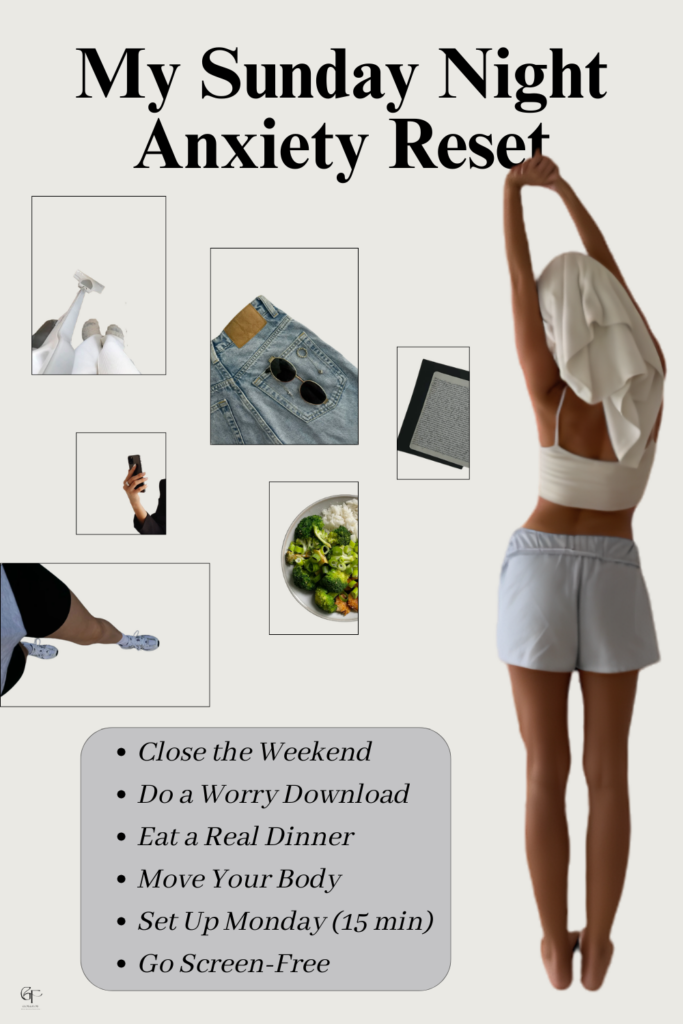
- Close the weekend with one small, deliberate task
- Do a worry download in your journal, then circle what’s in your control
- Eat a proper, unhurried dinner
- Move your body for 15–20 minutes to release physical tension
- Spend 15 minutes setting up Monday morning only
- Go screen-free for the last 90 minutes before bed
If you’re interested in my full Sunday reset routine, you can read my previous article, my full Sunday Reset Routine, where I share the simple habits that help me reset, recharge, and start the new week feeling more prepared.
FAQ: Sunday Night Anxiety
What causes Sunday night anxiety?
It’s usually anticipatory stress — your brain rehearsing the week ahead before it’s actually happened. Unfinished weekend tasks, poor sleep, and the lack of a clear transition ritual between weekend and workweek all make it worse.
Is Sunday night anxiety normal?
Yes, it’s an extremely common experience, often nicknamed the “Sunday scaries.” That doesn’t mean it should be ignored, but it does mean you’re not overreacting or broken — your nervous system is just responding to a predictable pattern.
How can I stop dreading Monday?
A short, repeatable Sunday evening routine — closing out the weekend, writing down your worries, and doing a brief Monday setup — helps most. The goal isn’t eliminating every task before bed; it’s reducing decision fatigue so Monday morning feels lighter.
Can a weekly reset routine actually help with anxiety?
A consistent weekly reset routine gives your brain a predictable rhythm, which lowers the sense of chaos that often fuels anxious spiraling. It won’t resolve deeper anxiety on its own, but it’s a genuinely effective piece of the puzzle.
When should I worry that it’s more than just the Sunday scaries?
If the dread is intense, doesn’t ease once Monday starts, or is paired with ongoing sleep problems, low mood, or dread about work most days, it’s worth talking to a doctor or therapist. The National Institute of Mental Health has helpful guidance on when everyday worry crosses into something that deserves professional support — it may be pointing to something beyond what a Sunday routine can fix.
Final Thoughts
Sunday night anxiety isn’t a flaw in your character — it’s a very common, very human response to an unclear transition and a racing mind. You don’t need a perfect ritual or a four-hour routine to feel better. You need a few small, repeatable steps that tell your nervous system: the weekend is closing gently, and you’re prepared.
Start with just one piece of this routine this Sunday — the worry download alone can make a real difference — and build from there. Give it a few weeks before deciding whether it’s working. Like most gentle habits, the effect tends to compound: the third Sunday usually feels calmer than the first, and by the sixth, the dread has often shrunk down to something manageable instead of something that ruins your evening.
Your turn
Which part of your Sunday tends to trigger the most anxiety — the unfinished to-do list, the early bedtime dread, or something else? Tell me in the comments, and if this helped, save it to Pinterest for next Sunday.