For anxious minds, the brain dump method can be especially helpful when your brain is running twelve tabs at once — the email you forgot to send, the argument you’re replaying, the thing you need to buy for tomorrow — and none of them will close. If your mind feels like a browser about to crash, a brain dump journal is the simplest tool I know for clearing the clutter without needing a single answer figured out first. You don’t need to fix anything. You just need somewhere to put it down.

My 2 A.M. Wake-Up Call
A while back, I used to wake up most nights around 2 a.m. with my mind already sprinting — bills, to-do lists, conversations I hadn’t had yet, things I’d said days ago that suddenly felt urgent again. I’d lie there trying to “think my way calm,” which never once worked. It just built momentum, one thought pulling the next one in behind it until I was wide awake and spiraling.
One night, out of pure exhaustion, I grabbed the notebook on my nightstand and wrote down every single thought exactly as it came — no order, no editing, no crossing anything out. Half of it didn’t even make sense. Ten minutes later, my chest felt lighter anyway. Nothing on the page had been solved. But it wasn’t spinning inside my head anymore either — it was just sitting quietly on paper, where I could look at it in the morning instead of at 2 a.m.
That one notebook page turned into a habit, and that habit turned into the method I want to walk you through here.
What Is a Brain Dump Journal?
At its core, this practice is exactly what it sounds like: a dedicated space where you empty every thought, worry, task, and half-formed idea onto the page without stopping to organize or judge any of it. Unlike a to-do list, there’s no pressure to make it useful right away — the point is simply to get everything out of your head and onto something outside of you.
Psychologists have studied this idea under the name “expressive writing” for decades. Research from the American Psychological Association found that writing about what’s on your mind can ease intrusive, circling thoughts and even free up cognitive resources that would otherwise be spent trying to suppress them. In plain terms: the more your mind is holding onto, the less room it has to actually function — and putting it on paper hands some of that weight back, instead of your nervous system carrying it alone.
That’s the idea behind every version of this practice, whether you call it a mind dump, a worry journal, or something else entirely. The name matters less than the habit itself.
How to Start a Brain Dump Journal for Anxiety
You don’t need a fancy notebook or a perfect system to begin. Anxiety journaling works best when it’s low-pressure, so start smaller than you think you need to.
Set a Timer, Not a Goal
Give yourself 5–10 minutes and write until the timer goes off, not until you “finish” — your thoughts won’t run out on a schedule anyway. Keep your pen moving even if what comes out is “I don’t know what to write.” That sentence counts too.
Skip Grammar, Skip Order
This isn’t an essay. Fragments, half sentences, and random tangents are not just allowed, they’re the whole point. The messier it looks, the more it’s probably working.
Three Prompts to Get Unstuck
If the blank page feels intimidating, try one of these:
- “Right now, my mind is stuck on…”
- “The three things taking up the most space in my head are…”
- “If I could hand one worry to someone else for the day, it would be…”
Paper or Digital — Which Should You Use?
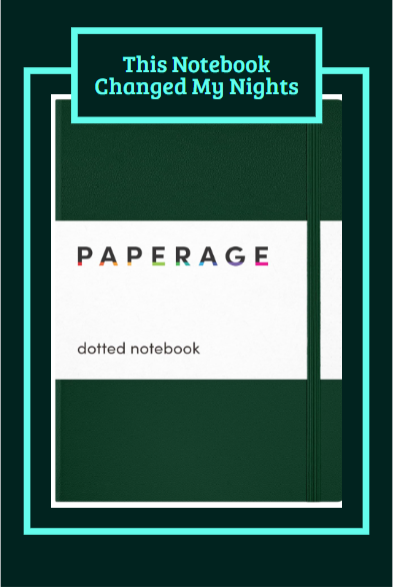
Paper tends to slow your thoughts down just enough to actually process them, which is why most people start there. A simple dot-grid notebook like [this one] works especially well for brain dumps — the faint grid keeps things loosely organized without forcing structure on you, and the pages lay flat, so you’re not fighting the notebook while you write.
But a notes app on your phone works too, especially if 2 a.m. is your trigger time and getting up to find a notebook feels like too much effort. The best format is whichever one you’ll actually reach for in the moment — this only works if it’s easy to start.
Brain Dump vs. Regular Journaling: What’s the Difference?
Regular journaling often has some shape to it — gratitude lists, reflections on your day, prompts about growth. This practice skips structure on purpose. It’s less “here’s how I feel about what happened” and more “here’s everything currently taking up space in my head, unfiltered.”
A few practical differences:
- Structure: Regular journaling often follows a prompt; this one follows nothing at all
- Timing: Regular journaling can happen anytime; this works best the moment your mind feels overloaded
- Goal: Regular journaling aims for reflection; this one aims purely for release
Think of it as the difference between tidying a room and just getting everything off the floor first. You need the second step before the first one is even possible — and for a lot of anxious minds, that first step is the part that’s been missing.
If you’re interested in the research behind why this works so well, I wrote in detail about five science‑backed benefits of journaling for anxiety relief in my earlier article: 5 Science Backed Benefits of Journaling for Anxiety Relief.
From Mental Clutter to Mental Clarity: The Soft Productivity Connection
There’s a reason this method fits so naturally into a soft productivity approach — the kind that prioritizes how you feel over how much you check off. When your mind is crowded, even simple tasks feel heavier than they are. Emptying that mental inbox first often makes the actual to-do list shrink on its own, because half of what felt urgent was really just noise.
Here’s what that looks like in practice: you sit down to work, but before you open your laptop, you spend five minutes writing out everything competing for your attention. Some of it turns out to be genuinely important. A lot of it turns out to be worry dressed up as urgency — and once it’s on paper, you can see the difference.
Mental clarity doesn’t come from squeezing in more, it comes from clearing enough space to see what actually matters. A short brain dump before you start your day — or before you try to sleep — does exactly that.
If you want to understand how this fits into the bigger picture of soft productivity — the kind that prioritizes emotional clarity over output — I break it down in more detail in my pillar post: What Is Soft Productivity?.

Making It a Daily Reset Journal Habit
This works best as a daily reset journal, not a one-time fix. You don’t need a long session — even two minutes at a consistent time builds the habit.
Morning or Evening?
Morning works well if racing thoughts hit you before you’re even out of bed; getting them onto paper before your day starts can keep them from setting the tone for everything after. Evening works well if your mind speeds up right when you’re trying to wind down, since it gives those thoughts somewhere to land besides your pillow. There’s no wrong choice — try both for a week and notice which one actually leaves you calmer.
Mayo Clinic lists journaling among its recommended strategies for managing chronic stress, alongside things like deep breathing and staying connected with people you trust. It doesn’t need to replace those — it pairs well with almost any calming routine you already have.
Quick Recap
- This practice is a judgment-free space to empty every thought onto paper, no structure required
- Set a timer (5–10 minutes) instead of a goal, and let the writing be messy
- Use simple prompts if the blank page feels intimidating
- It differs from regular journaling by skipping reflection and structure entirely
- Pairing it with soft productivity habits can shrink your to-do list and boost mental clarity
- Make it a short daily reset journal habit — morning or night, whichever fits your anxiety pattern

FAQ
What is a brain dump journal used for?
It’s used to unload racing thoughts, worries, and to-dos onto paper without organizing or solving them right away. It’s meant to relieve the feeling of mental overload, not to produce a finished, structured entry.
How do I get started with anxiety journaling like this?
Start small: set a 5-minute timer, grab any notebook, and write without stopping to edit. Using a simple prompt like “right now my mind is stuck on…” can help if you don’t know where to begin.
What’s the difference between a brain dump and regular journaling?
Regular journaling usually follows a prompt or reflects on your day, while a brain dump has no structure at all — it’s simply everything in your head, transferred to paper, in whatever order it arrives.
How often should I do a brain dump?
Daily is ideal if anxiety is a regular pattern for you, even if each session is only a few minutes. Some people also use it situationally, whenever their thoughts start to feel unmanageable, rather than on a set schedule.
Can it help me sleep better?
Many people find that writing down racing thoughts before bed makes it easier to fall asleep, since the thoughts feel “held” somewhere instead of needing to be remembered. It’s not a guaranteed fix, but it’s a low-effort one worth trying.
Do I need any special supplies to start?
No. A blank sheet of paper, the back of a receipt, or a notes app all work equally well. The method matters far more than the materials — the goal is to lower the barrier to starting, not raise it.
That said, if a completely blank page feels more overwhelming than helpful, a guided option like: Worry for Nothing: Guided Anxiety Journal can bridge the gap — it uses CBT-based prompts to walk you through the same release process with a bit more structure. Either way works; use whichever gets you to actually start.

Final Thoughts
You don’t need the right words, the right notebook, or even a clear reason — you just need somewhere to put down what your mind is currently carrying. A brain dump journal won’t erase your worries, but it can stop them from crowding out everything else. Some nights, that’s more than enough.
Your Turn
Try a 5-minute brain dump tonight and save this post to Pinterest so you can come back to the prompts whenever your mind needs the reset. If you try it, I’d love to hear how it felt in the comments.