Knowing how to help someone having a panic attack is one of the most valuable things you can learn — and yet almost no one teaches it. There’s a particular kind of helplessness that comes from watching someone you care about fall apart in front of you. Their breathing goes ragged, they grab your arm, their eyes are wide and terrified — and you freeze, because you have absolutely no idea what to do.
Most of us have been in that position. And most of us, without meaning to, have said or done exactly the wrong thing.
This article is for you. By the time you finish reading it, you’ll know precisely what to say, what to do, and what to avoid in those first critical moments. We also cover grounding techniques, what not to say, and when to seek medical help.

What’s Actually Happening in the Body During a Panic Attack
Before you can help someone having a panic attack, it helps to understand what you’re actually dealing with.
A panic attack is not a mental breakdown. It’s not someone being dramatic. It’s a full-scale physiological alarm — the body’s ancient fight-or-flight system firing without any actual threat to respond to.
The amygdala, the brain’s threat-detection center, sends out a red alert. Adrenaline floods the system. The heart rate spikes. Breathing becomes shallow and fast. Muscles tense. Blood rushes away from the digestive system toward the limbs. The body is preparing to either fight a predator or run from one — except there’s no predator. There’s just a crowded subway, or a meeting room, or a seemingly ordinary Tuesday afternoon.
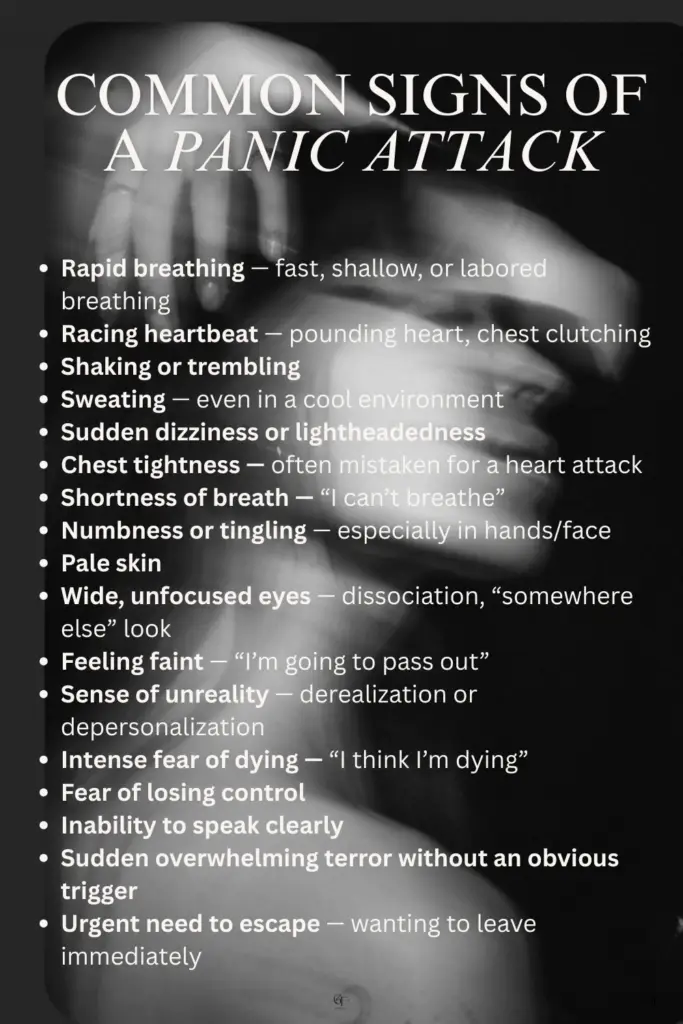
This misfiring creates terrifying physical sensations: a pounding or racing heart, the feeling of not being able to breathe, trembling, dizziness, tingling in the hands, a strange sense of unreality (called derealization), and — almost universally — a convinced, bone-deep certainty that something catastrophic is about to happen. That they’re having a heart attack. That they’re going to die.
They are not going to die. But knowing that doesn’t make the experience any less real. According to the American Psychological Association, panic disorder affects approximately 4.7% of adults at some point in their lives — making this far more common than most people realize.
For you as the helper, the most important thing to internalize is this: you don’t need to panic. This is not a medical emergency in most cases. You don’t need to call an ambulance. What you need to do is stay calm and stay present.
How to Recognize When Someone Is Having a Panic Attack
Panic attacks tend to arrive fast and hard. The intensity peaks within about ten minutes and then — though it may not feel this way to the person experiencing it — it begins to ease.
Watch for: rapid or labored breathing, a racing or pounding heart (they may clutch their chest), shaking or trembling, sweating, pallor, and that wide-eyed, “somewhere else” look that signals dissociation or derealization. The person may say things like “I can’t breathe,” “I’m going to faint,” “I think I’m dying.” They may not be able to hold a coherent conversation. They may not be able to respond to logical reassurance at all.
A panic attack differs from a generalized anxiety episode, which tends to be slower, more diffuse, and less physically overwhelming. With a panic attack, the onset is sudden and the symptoms are acute. With anxiety, the person may be able to talk to you, reason with you, and engage — they’re distressed, but they haven’t been swamped. The National Institute of Mental Health offers a detailed breakdown of the differences between panic disorder and generalized anxiety disorder if you’d like to read further.
The First 30 Seconds: How to Help Someone Having a Panic Attack Right Now
This is where it counts most. What you do in the first half-minute sets the tone for everything that follows.
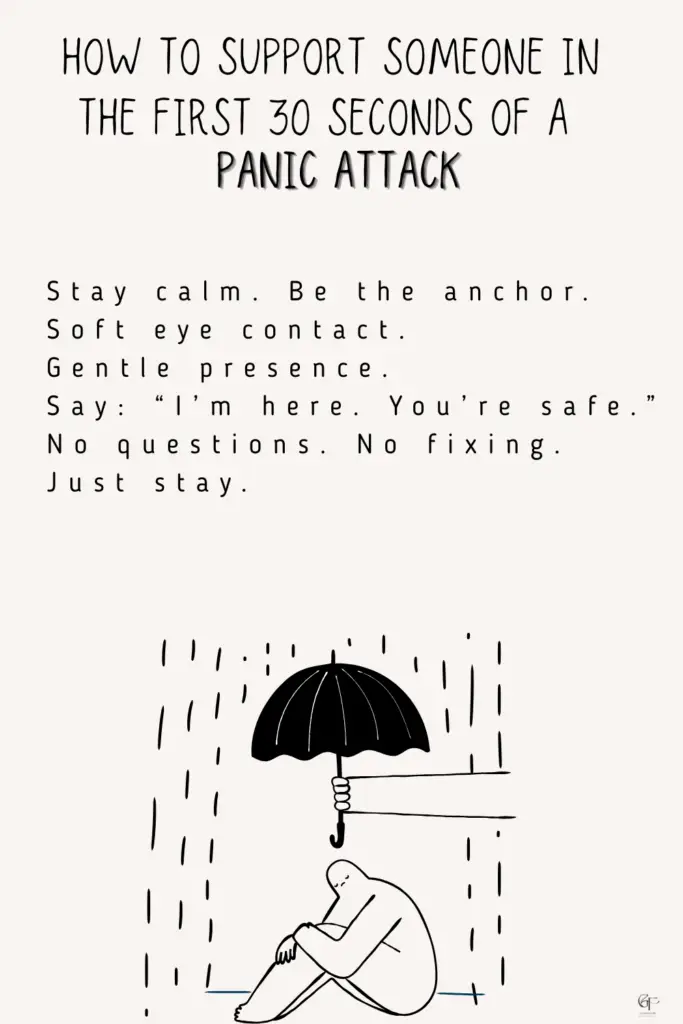
Stay calm. This is not optional. The human nervous system is deeply social — we co-regulate with each other constantly. If you’re visibly panicking, the person in front of you will escalate. If you’re grounded and steady, their nervous system will slowly, unconsciously begin to mirror yours. You are the anchor. Be an anchor.
Make contact. Get down to their level if they’re sitting or on the ground. Make eye contact — gentle, not intense. Say, simply and calmly: “I’m here. You’re safe.”
That’s it. That’s the whole job for the first thirty seconds.
Don’t fire questions at them. Don’t tell them to breathe. Don’t try to explain what’s happening or reassure them that there’s nothing wrong. None of that will land. Their prefrontal cortex — the reasoning, language-processing part of the brain — is essentially offline right now. Logic won’t reach them.
What reaches them is presence, steadiness, and a calm voice saying I see you, I’m not leaving, you’re not alone.
What to Say — and What to Never Say
Words matter enormously here. Some phrases help. Others, even when well-intentioned, make things significantly worse.
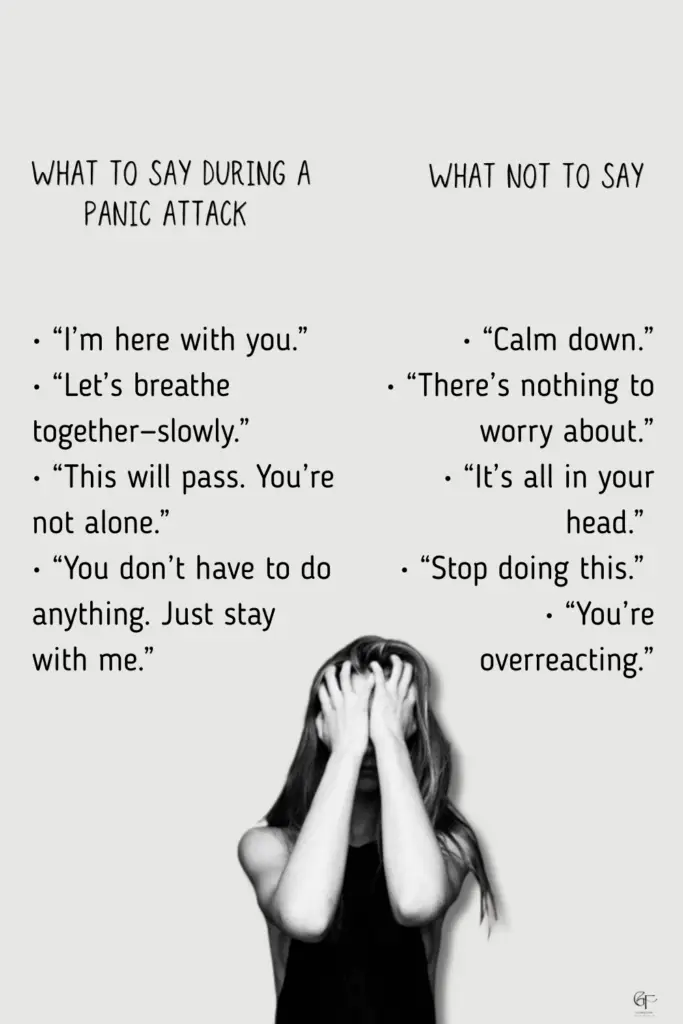
What to Say When Helping Someone Through a Panic Attack
- “I’m here with you.”
- “Let’s breathe together — slowly.”
- “This will pass. You’re not alone.”
- “You don’t have to do anything right now. Just stay with me.”
What Never to Say
- “Calm down.” (They can’t. And being told to makes it worse.)
- “There’s nothing to worry about.” (Their body disagrees, loudly.)
- “It’s all in your head.” (Technically true, functionally useless and deeply invalidating.)
- “Stop doing this.” (This implies choice. There is no choice.)
- “You’re overreacting.” (This is the most harmful thing you can say.)
The theme here: don’t argue with their nervous system. You will not win. Instead, meet them where they are, without judgment and without urgency.
Techniques That Actually Work When Helping Someone Having a Panic Attack
Once the person knows you’re there and you’ve established some basic calm, you can gently introduce some grounding techniques. Don’t force these — offer them softly, and follow the person’s lead.
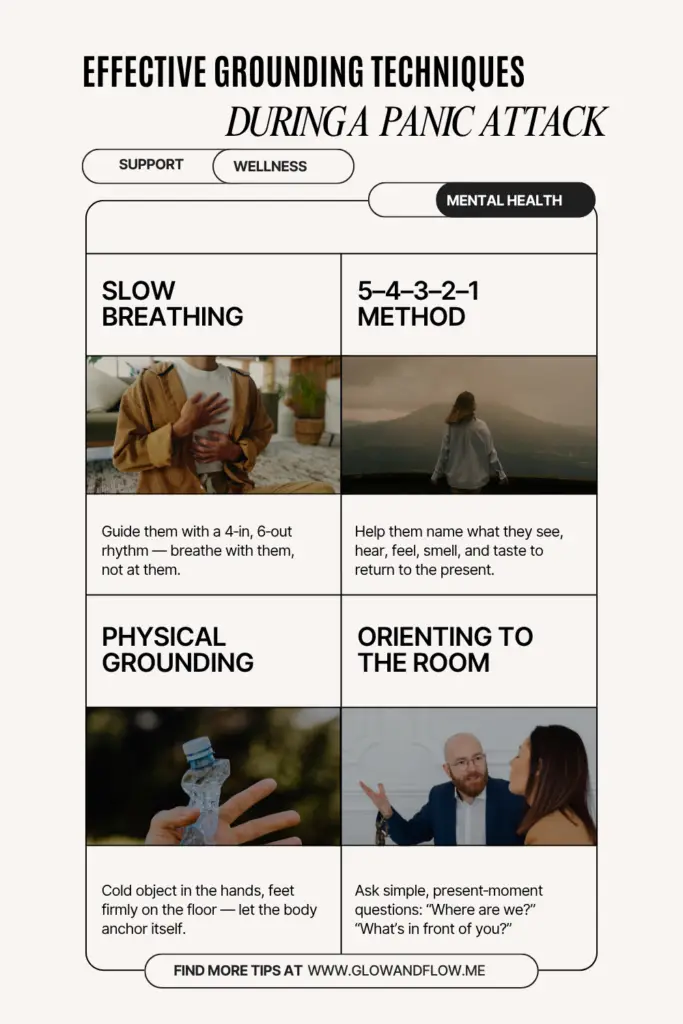
Breathing Together
Slow, extended exhales activate the parasympathetic nervous system — the body’s “rest and digest” mode, the opposite of fight-or-flight. Guide the person gently: breathe in for four counts, breathe out for six. Do it with them. Don’t instruct from a distance — breathe visibly, audibly, so they can follow your rhythm. You’re a metronome, not a coach.
Research published in Frontiers in Human Neuroscience supports slow-paced breathing as an effective method for reducing acute anxiety and activating the parasympathetic nervous system.
The 5-4-3-2-1 Grounding Method
This technique gently pulls attention back to the present moment using the senses. Ask, slowly and softly:
- “Can you tell me five things you can see right now?”
- “Four things you can hear?”
- “Three things you can physically feel?”
- “Two things you can smell?”
- “One thing you can taste?”
You’re not drilling them. You’re giving their mind something concrete to hold onto — a ladder out of the spiral.
Physical Grounding
A cold object held in the hands (a water bottle, a piece of ice, a metal surface) can be remarkably effective. The sharp physical sensation breaks through the fog. If you’re outdoors or somewhere with a solid floor, ask them to press their feet flat against the ground: “Feel the floor holding you. You’re not going anywhere.”
Orienting to the Present
Ask simple, present-moment questions: “Where are we right now?” “What’s the first thing you see in front of you?” “What color is the chair you’re sitting on?” These questions don’t demand complex thought — they just ask the person to look around and notice. That act of noticing is itself stabilizing.
Move to a Quieter Space
If you’re somewhere loud, crowded, or overstimulating, gently guide them toward somewhere calmer — a side street, a quiet room, a bench away from the crowd. Ask, don’t command: “Would it help to move somewhere quieter?” Let them decide.
When They Don’t Want to Talk
Sometimes the person will close down entirely. They won’t want to answer questions. They won’t want breathing exercises. They’ll want to curl in on themselves and not be touched.
That’s okay. Sit with them anyway. You don’t need to say anything. You don’t need to fix anything. Your calm, steady presence is its own kind of medicine.
A quiet “I’m right here. You don’t have to say a word” is enough. Don’t leave. Don’t scroll your phone. Don’t start a side conversation. Just be there, fully, in whatever way they need.
When to Call for Medical Help
Most panic attacks resolve on their own within 20 to 30 minutes. But there are situations where you should seek medical assistance immediately:
- Chest pain that doesn’t ease as the attack subsides
- The person has a known heart condition
- They lose consciousness or come close to fainting
- Symptoms don’t improve after 30 minutes
- You’re not sure — and your gut says something is wrong
When in doubt, err toward caution. A paramedic who shows up unnecessarily is far better than the alternative.
After the Storm: What to Do When It’s Over
A panic attack is exhausting. The body has been through a full adrenaline surge and crash. The person will likely feel shaky, drained, embarrassed, or all three.
Give them time. Don’t debrief immediately. Don’t analyze what happened or try to find the trigger. Offer something simple and concrete: “Can I get you some water?” or “Do you want to sit here for a few more minutes?”
Later — not now, but later — you can gently ask if they want to talk about it. Some people find it helpful to process what happened. Others don’t. Follow their lead.
If You Know Someone Who Struggles with Anxiety Regularly
If someone close to you deals with panic attacks often, the most valuable thing you can do is have a calm conversation between episodes — when everyone is regulated and relaxed. Understanding how to help someone having a panic attack before it happens gives you a real head start.
Ask them: “What helps you most when you’re in that state? Is there anything you’d like me to do — or not do?” Create a simple understanding together. Maybe it’s a code word that signals they need to leave a situation. Maybe it’s knowing that you’ll always step outside with them. Maybe it’s keeping a cold water bottle in your bag.
You might also explore grounding apps, breathing timers, or fidget tools together — not as fixes, but as part of a toolkit they can reach for. The Calm app and Insight Timer both offer guided breathing exercises that can be helpful between sessions with a therapist.
Common Mistakes to Avoid When Trying to Help
Even caring, thoughtful people make these errors when trying to help someone having a panic attack:
- Asking too many questions too fast
- Offering advice during the attack (“Maybe you should try yoga”)
- Dismissing the severity because the person “seems fine now”
- Blaming or shaming (“You always do this in public”)
- Trying to muscle through the situation — physically steering the person, speaking urgently, creating more stimulation
The common thread: trying too hard to fix it. Panic attacks can’t be fixed in the moment. They have to move through. Your job is to make the passage safer, not shorter.
What It Really Means to Help Someone Having a Panic Attack
Here’s the truth that most guides leave out: you don’t have to do everything perfectly. You don’t need a certification. You don’t need to remember every technique.
What you need to do is stay. Be steady. Make the person feel less alone in what is, for them, one of the most frightening experiences imaginable.
The research on what helps most in acute anxiety consistently points to one thing above all else: perceived support. Not the right words. Not the right technique. Just the felt sense that someone is there and isn’t leaving.
You are capable of that. You already have everything it requires.
Next time you’re standing beside someone who’s drowning in their own nervous system, remember: you don’t need to pull them out. You just need to stay in the water with them until it calms.
That is enough. That is everything.
If you or someone you know experiences frequent panic attacks, speaking with a mental health professional can make a meaningful difference. Cognitive behavioral therapy (CBT) and other evidence-based approaches have strong track records in treating panic disorder. If you’d like to explore further, the Anxiety and Depression Association of America (ADAA) is an excellent starting point for finding qualified therapists and up-to-date resources.
If you enjoyed this article and want to dive deeper into practical, evidence‑based ways to manage anxiety, you might also like my earlier piece: 8 Science-Backed Anxiety Relief Methods Therapists Actually Use. It expands on the same theme with clear, therapist‑approved strategies you can start using right away.