Managing summer heat on antidepressants is one of those things nobody warns you about at the pharmacy — and yet it affects millions of people every single year.
You step outside, the sun hits you, and within minutes you feel dizzy, weak, slightly nauseous, and vaguely like you might faint. Meanwhile, everyone around you seems completely fine. They’re eating ice cream, laughing, living their best lives. And you’re quietly gripping a wall, wondering if you’re dying.
You’re not. But your medication is making the heat significantly harder on your body — and once you understand why, you can actually do something about it. In this post I’m sharing what I’ve learned from two years of trial, error, and a lot of scientific reading — plus the practical tricks that genuinely help me get through summer in one piece.

(Quick note before we dive in: I’m not a doctor or medical professional. Everything here is based on my own experience and information from peer-reviewed sources and medical institutions. Always talk to your prescriber before making any changes to your treatment.)
My Story: Two Years In and Still Learning
I’ve been dealing with anxiety for years. It’s the kind that doesn’t always show on the outside but is pretty relentless on the inside — the constant low hum of worry that makes it hard to sleep, hard to concentrate, hard to just be somewhere without your brain running worst-case scenarios in the background.
Two years ago, I started antidepressants. And honestly? They helped. The medication didn’t fix everything, but it turned the volume down enough for me to actually engage with my life again.
Then summer came.
I noticed pretty quickly that something was off. A short walk to the market left me feeling shaky and drained. A day trip I’d been looking forward to turned into me sitting on a bench in the shade, dizzy and nauseous, watching everyone else enjoy themselves. One afternoon I came genuinely close to fainting outside — the kind where your vision goes dark at the edges and your legs turn to water — and I had to sit on the ground until it passed.
I had no idea what was happening. I wasn’t drinking. I wasn’t in extreme heat. I just… couldn’t handle it anymore the way I used to.
It was only after a lot of reading that I connected the dots: antidepressants can significantly amplify the body’s sensitivity to heat. And this is something that almost nobody talks about. Knowing that it wasn’t weakness, it wasn’t in my head, and that I wasn’t alone — that changed everything.
What’s Actually Happening in Your Body
Managing summer heat on antidepressants becomes more challenging because these medications can affect the body’s natural temperature-regulation system. A key player in this process is the hypothalamus, a small region deep in the brain that acts as your body’s internal thermostat. It controls sweating, blood flow, and thirst to help keep your body at a safe temperature.
The challenge is that antidepressants can influence this system. Most work by increasing levels of serotonin — and sometimes norepinephrine — in the brain. While serotonin is best known for its role in mood regulation, it also plays an important role in controlling body temperature.
As a result, some antidepressants can make it harder for the body to cool itself efficiently. They may increase sweating, which can lead to dehydration, or reduce sweating, making it more difficult to release excess heat. Some medications may also affect thirst signals, meaning you might not feel the need to drink water even when your body needs it most (According to psychiatrists at Yale School of Medicine).
These effects often become noticeable during hot weather, which is why many people feel more sensitive to heat in the summer months. It’s not that the medication suddenly stops working — it’s that your body has to work harder to adapt to high temperatures.

Which Antidepressants Cause More Heat Side Effects?
Not all antidepressants affect the body the same way in the heat. Here’s a breakdown of the main classes — and why managing summer heat on antidepressants looks different depending on what you’re taking.
SSRIs (such as Prozac, Zoloft, and Lexapro) commonly increase sweating, which can lead to dehydration during hot weather. Around 10–14% of users report this side effect.
Older tricyclic antidepressants (TCAs), such as amitriptyline and imipramine, may have the opposite effect by reducing sweating. While this may seem beneficial, it can increase the risk of overheating because the body is less able to cool itself. The CDC’s guidance highlights TCAs as medications that can impair cooling.
SNRIs (such as duloxetine and venlafaxine) can also increase sweating and affect the body’s temperature regulation. If you take antidepressants alongside other medications, such as diuretics or beta-blockers, the combined effects may further increase heat-related risks, making it important for your healthcare provider to be aware of all medications you use.
Tips That Actually Help
This is the part I wish someone had handed me two years ago. Managing summer heat on antidepressants requires some real adjustments — but they’re all doable once you know what you’re working with.
Plan your schedule around the heat, not the other way around. I stopped trying to do errands between noon and 4pm in summer. I do everything in the morning before 10am or wait until the evening. It’s a small logistical change but it’s made a huge difference. The hottest part of the day is simply not for me anymore — and I’ve stopped feeling bad about that.
Drink water on a timer, not on thirst. Since antidepressants can suppress the thirst signal, I don’t trust mine. I set a phone reminder to drink water every 45 minutes when it’s hot. I also drink two full glasses of water before leaving the house on any warm day. It sounds like a lot but it’s the single most effective thing I do.
No alcohol, no caffeine on hot days. Both are diuretics. Both increase dehydration. I’ve had a couple of bad experiences mixing a single glass of wine with summer heat and antidepressants, and I don’t do it anymore. It’s not worth it.
Dress like you mean it. Loose linen trousers, a light cotton top, a wide-brimmed hat, and sunglasses aren’t style choices for me in summer — they’re protective gear. I also keep a small spray bottle of water in my bag. Spritzing your wrists, neck, and temples when you feel the heat rising works surprisingly fast.
Sunscreen is non-negotiable. Some antidepressants — especially TCAs — can increase UV sensitivity. I use SPF 50 on my face and SPF 30 on the rest of me, every single day from May to September, and I reapply if I’m outside for more than two hours.
Make your home a refuge. I close the blinds on south-facing windows from early morning. I run a fan at night aimed at the window to draw in cooler air. On the worst days, I take a lukewarm (not cold) shower in the afternoon — cold water actually makes your blood vessels contract and can make you feel worse, counterintuitively. Lukewarm works better.
Move exercise indoors. I used to love running in summer. Now I do it indoors or at 6:30am before the heat builds. It was a frustrating adjustment but it beats the alternative of collapsing on a trail somewhere.
Talk to your doctor before summer starts. This is probably the most important tip of all. Your prescriber may be able to adjust your dose timing, suggest the lowest effective dose for the season, or flag any interactions with other medications you’re taking. I wish I’d had this conversation earlier. Medical experts recommend regular counselling on heat-related risks for anyone on antidepressants — and it should be standard practice, not something you have to ask about.
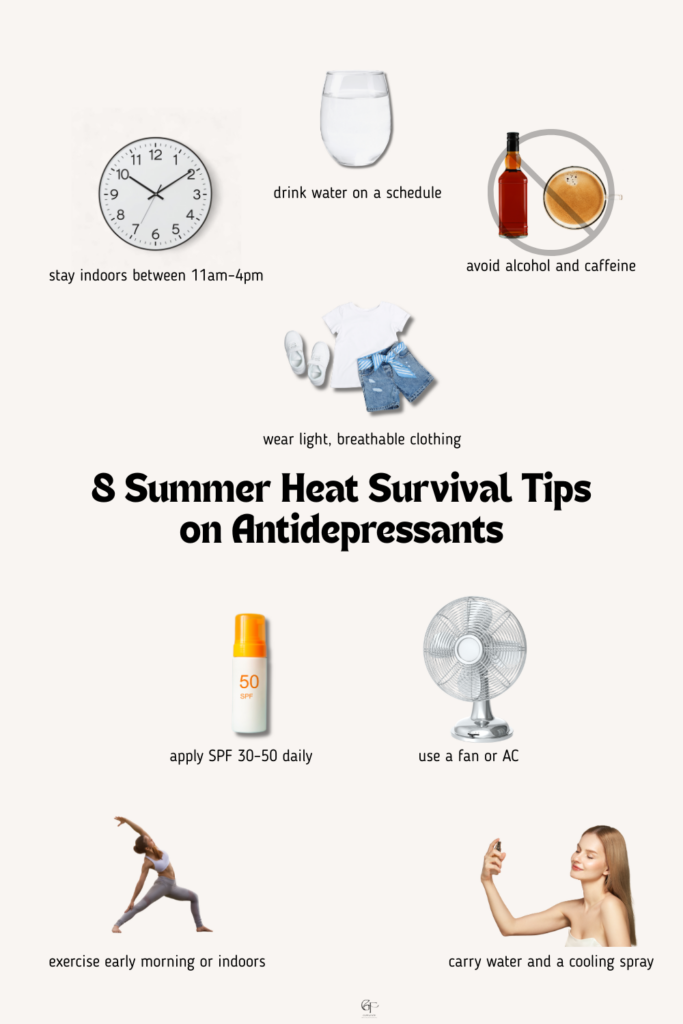
Quick Overview: Managing Summer Heat on Antidepressants
Here’s a fast summary of what works:
- Stay indoors between 11am–4pm on hot days
- Drink water on a schedule — don’t wait until you’re thirsty
- Avoid alcohol and caffeine in warm weather
- Wear light, breathable clothing and a hat
- Apply SPF 30–50 daily, reapply outdoors
- Use a fan or AC and keep curtains closed during the hottest hours
- Exercise early morning or indoors only
- Carry water and a cooling spray when you go out
- Know your warning signs and get to a cool space immediately if they appear
- Speak to your prescriber before summer — not after a bad episode
When to Worry: Warning Signs You Shouldn’t Ignore
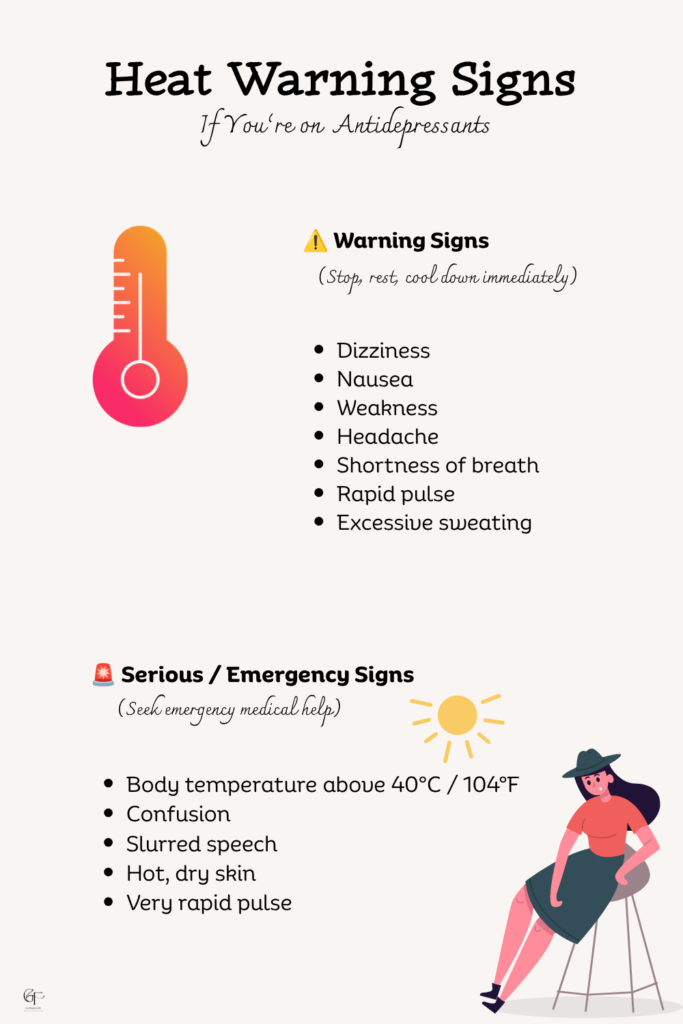
It’s important to know when heat is becoming a health risk. Stop, rest, and cool down immediately if you experience dizziness, nausea, weakness, headache, shortness of breath, a rapid pulse, or excessive sweating.
Heatstroke is a medical emergency. Warning signs include a body temperature above 40°C (104°F), confusion, slurred speech, hot and dry skin, and a very rapid pulse. According to the CDC, emergency services should be called immediately if heatstroke is suspected.
If you take antidepressants and have experienced severe dizziness, faintness, or nausea in hot weather, discuss it with your doctor.
Final Thoughts
I spent almost a full summer thinking I was being weak. That other people just handled heat better, that I needed to push through, that the near-fainting episodes were a me-problem and not a medication-problem.
They were a medication-problem. And knowing that — really knowing it, backed by science — made me so much more compassionate with myself.
Managing summer heat on antidepressants is harder. That’s not an excuse, it’s a fact. Around 1 in 6 Americans take psychiatric medications, and most of them have no idea this is coming. You don’t have to white-knuckle your way through summer. You just need to adjust — and you’re allowed to do that.
Your medication is helping you. Now help it by giving your body what it needs to stay safe in the heat.
Did this resonate with you? Drop a comment below and tell me how heat affects you on antidepressants — I’d love to know I’m not the only one who’s had a lamppost moment.
If you found this helpful, you might also want to read: 👉 8 Science-Backed Anxiety Relief Methods Therapists Actually Use.