What Nobody Talks About
You weren’t beaten. You weren’t abandoned. Nobody would look at your childhood and call it traumatic.
And yet — something feels off. You struggle to name your emotions, you feel deeply lonely even in a room full of people, and no matter how much you achieve, it never quite feels like enough. If that resonates, you might be looking at childhood emotional neglect in adults — one of the most overlooked roots of adult emotional pain.

My Story: Nothing Happened. And That Was the Problem.
For a long time, I considered myself lucky.
When others talked about their childhood traumas — abusive parents, addiction, violence — I’d stay quiet. My story didn’t seem to measure up. My parents worked hard. There was food on the table, a roof over our heads. My relationship with my sibling was — and still is — one of the most important in my life.
If someone had asked me ten years ago whether I had a happy childhood, I would have said yes without hesitation.
But then I started going deeper into self-awareness work.
And I slowly realized something: it’s not only what happened to us in childhood that shapes us. It’s also what didn’t happen.
I was a anxious little girl. I had trouble making friends. I was quiet, withdrawn, rarely the one to initiate. When other kids reached out to me, invited me to play, tried to get close — I often didn’t feel joy. I felt shame. A deep, quiet voice that whispered: you don’t deserve this.
I cried a lot as a child. I had tantrums. I acted out. For years I believed I was simply a “difficult kid.” But as an adult, I found a completely different explanation: I wasn’t a bad child. I was a child desperately hungry for attention.
My parents worked constantly. Looking back, I can see they were carrying their own burdens, their own unhealed wounds. My sibling and I often felt like we existed somewhere in the background.
I have no memory of my parents playing with us. No shared games, no silly moments, no one sitting down beside me simply because they were curious about my inner world.
That doesn’t mean they didn’t love us. But I know now that love and emotional presence are not the same thing.

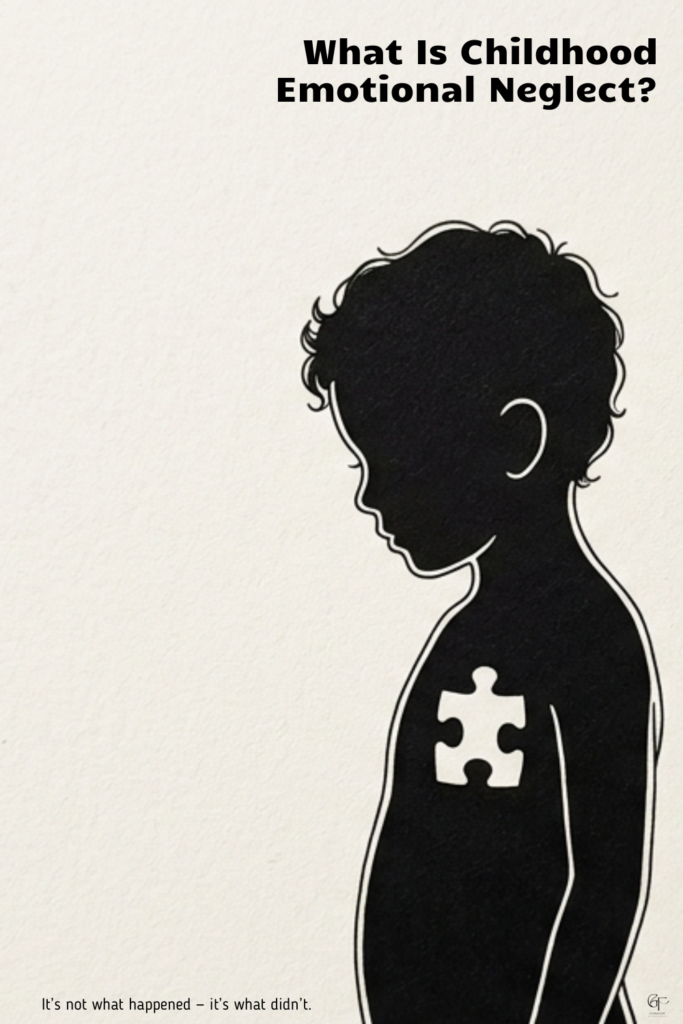
What Is Childhood Emotional Neglect?
Childhood emotional neglect (CEN) isn’t what most people picture when they hear the word “neglect.” There’s no dramatic event to point to. No single moment that broke everything.
Emotional neglect happens when a child’s emotional needs are consistently unmet — not necessarily out of cruelty, but out of absence, busyness, or a parent’s own emotional limitations. According to psychologist Dr. Jonice Webb, who coined the term, CEN is defined not by what was done, but by what wasn’t.
The child feels sad — but no one helps them understand why. The child is scared — but receives no comfort. The child cries — and hears: “Don’t cry. Others have it much worse.”
What the child learns isn’t how to handle emotions. They learn that their emotions are a problem.
The wound isn’t a memory. It’s an absence of memories.
10 Hidden Signs of Childhood Emotional Neglect in Adults
Childhood emotional neglect in adults often shows up in subtle, deeply ingrained ways. Here are ten signs that may be quietly running in the background of your life.
1. You Feel Empty for No Reason
You might have a good life on paper — a job, relationships, a routine — and still feel a persistent hollowness inside. This vague emptiness is one of the hallmarks of CEN. When emotions aren’t named and validated in childhood, adults can grow up feeling oddly disconnected from their own inner life.
2. You Don’t Know What You’re Feeling (or Feel Nothing at All)
If someone asks “how are you feeling?” and your honest answer is “I have no idea” — that’s worth paying attention to. Emotional neglect doesn’t kill feelings, but it does make them harder to recognize and name. Psychologists call this alexithymia, the difficulty identifying and describing emotions, and it’s strongly associated with CEN. Research from the Harvard Center on the Developing Child shows that early emotional responsiveness from caregivers is foundational to healthy emotional development.
3. You’re Your Own Harshest Critic
Adults who experienced childhood emotional neglect often internalize a relentless inner critic. Because their needs were consistently overlooked, they unconsciously concluded that they were the problem. This can show up as perfectionism, chronic self-blame, or a deep sense that you’re never quite “enough.”
4. You Feel Lonely Even Around People
This was one of the most confusing experiences for me personally. I had friends. I had people around me. And yet I frequently felt profoundly alone. Real connection requires being seen — the whole self, including the messy, vulnerable parts. If you learned early on that your emotional world was too much for others, you likely learned to hide it. And when only the surface version of you connects with others, loneliness follows.
5. You Struggle to Ask for Help
Asking for help means admitting you have a need — and if your childhood needs were routinely dismissed or ignored, that can feel unbearably vulnerable. Adults with CEN often over-rely on themselves, push through difficulties alone, and feel a disproportionate amount of shame around needing support.
6. You’re a People-Pleaser Who Can’t Say No
When a child learns that their emotions create tension, they adapt by becoming very good at managing the emotions of others instead. In adulthood, this looks like chronic people-pleasing — difficulty saying no, constant vigilance about others’ moods, and a deep discomfort with any hint of conflict or disapproval.
7. You Struggle with Anxiety — Especially Social Anxiety
Unresolved childhood emotional neglect is closely linked to generalized anxiety and social anxiety in adults. According to the American Psychological Association, early relational experiences directly influence how the nervous system learns to perceive safety and threat. If comfort was unpredictable or absent in childhood, the nervous system stays on alert long into adulthood. [internal link: How to Manage Social Anxiety as an Adult]
8. You Minimize Your Own Pain
“Others have it so much worse.” Sound familiar? Adults with CEN are experts at dismissing their own suffering. Because they were taught — explicitly or implicitly — that their emotions were excessive or inconvenient, they develop a habit of shrinking their own pain. This makes it very hard to seek help, because some part of you doesn’t believe you deserve it.
9. You Have Trouble with Intimacy and Deep Relationships
Emotional neglect leaves a specific kind of relational wound: the belief that your authentic self is too much, or not enough, to be truly loved. This can make deep intimacy feel terrifying. You might keep relationships at a surface level, struggle with vulnerability, or find yourself repeatedly drawn to emotionally unavailable partners.
10. You Don’t Really Know Who You Are
A healthy sense of self develops when our inner world is reflected back to us — when caregivers are curious about our feelings, our preferences, our experiences. Without that mirroring, adults can grow up feeling strangely undefined. You might be very good at adapting to others while having little idea what you actually want, feel, or value for yourself.
Quick Checklist: Do Any of These Sound Like You?
Here’s a quick overview of the 10 hidden signs of childhood emotional neglect in adults:
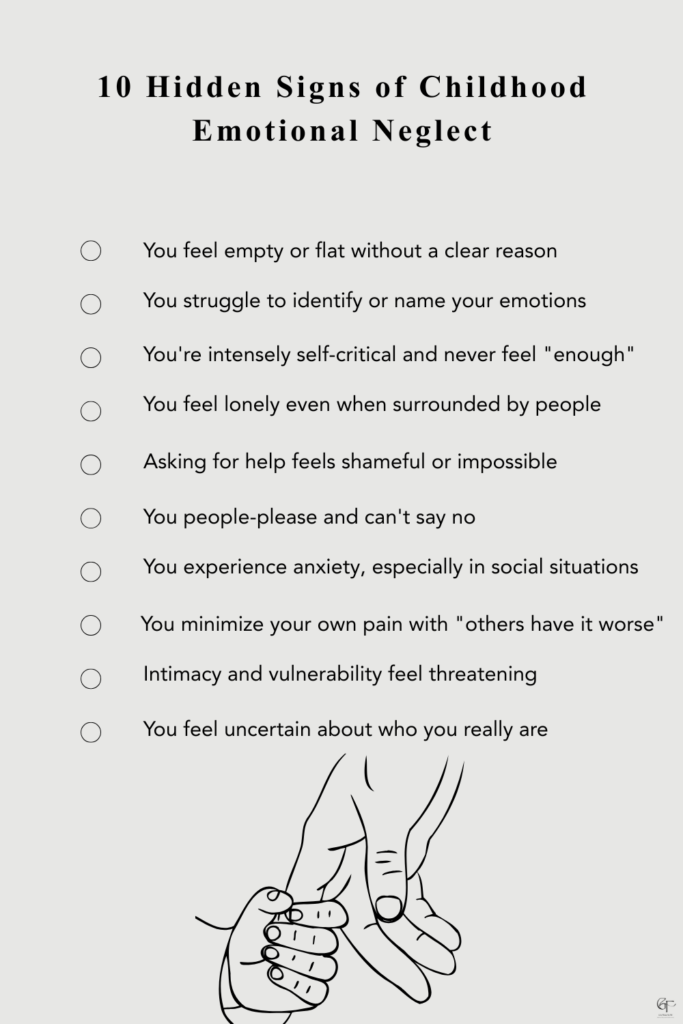
If several of these resonate, you’re not broken. You’re someone whose emotional needs weren’t fully met — and there is a way forward.
Can You Heal From Childhood Emotional Neglect?
Yes. Not quickly, not perfectly, and not without effort. But yes.
For me, the first step was simply understanding. Realizing I wasn’t fundamentally flawed. That I wasn’t too sensitive, too much, too difficult. That there were wounds I was now old enough to begin healing.
Healing from childhood emotional neglect in adults can look like:
- Therapy, particularly approaches like emotionally focused therapy or schema therapy, which help rewire early relational patterns
- Journaling to slowly reconnect with your inner emotional world
- Learning to name emotions — even just starting with a feelings wheel can help
- Safe relationships where you practice letting yourself be seen
- Self-compassion practices that offer you what you didn’t receive as a child
The most important thing, perhaps, is learning to give yourself now what you needed then: attention, patience, understanding, and the radical belief that your inner world matters.
Final Thoughts
Childhood emotional neglect in adults is so easy to miss — precisely because it leaves no visible scars. No dramatic incident, no obvious villain. Just a quiet absence that slowly shapes the way you relate to yourself and others.
If you grew up wondering why you felt so alone, so anxious, so unsure of your own worth — it wasn’t because something was wrong with you. It was because something was missing for you.
And you can start filling that in, one small step at a time.
Did any of these signs resonate with you? I’d love to hear your thoughts in the comments below — you might be surprised how many others share this experience.
Save this post to Pinterest if you found it helpful, or share it with someone who might need to read it.
Want to go deeper? Read next: 8 Science-Backed Anxiety Relief Methods Therapists Actually Use