Essential Questions can help reveal what anxiety has been trying to tell you all along.
For a long time, I avoided anything that made me uncomfortable. Crowded places, difficult conversations, even certain thoughts. I told myself I was protecting my nervous system. I was being careful. Responsible, even. But the avoidance didn’t make the anxiety smaller — it made the world feel smaller. And the anxiety? It got louder.
Here’s what nobody tells you early on: anxiety almost always has a reason. It’s not random, and it’s not a personality flaw. It’s your mind and body trying to communicate something — a fear that hasn’t been named, a need that hasn’t been met, a wound that hasn’t been tended to. The problem is that when we’re in the thick of it, we’re too busy trying to survive the feeling to actually listen to it.
That’s where the right questions come in.
“The first time I sat down and actually asked myself what I was afraid of — really afraid of, underneath the racing heart and the catastrophic thinking — I cried for about twenty minutes. Not because the answer was devastating, but because it was so obvious. I had been so busy managing the symptoms that I had completely ignored the source.”
These 30 questions to ask yourself about anxiety aren’t a magic cure. They’re a flashlight. They’re meant to help you look at what’s actually going on — gently, honestly, without judgment. Some of them will feel easy. Others will sit in your chest for days. Both of those reactions are useful information.
Work through them slowly. Write your answers down if you can. You don’t have to finish in one sitting.

Section 1: Understanding the Physical Experience of Anxiety
Before you can understand why you’re anxious, it helps to get clear on what anxiety actually feels like in your body. Many people spend years treating anxiety as a purely mental problem while ignoring the very real physical signals their body is sending.
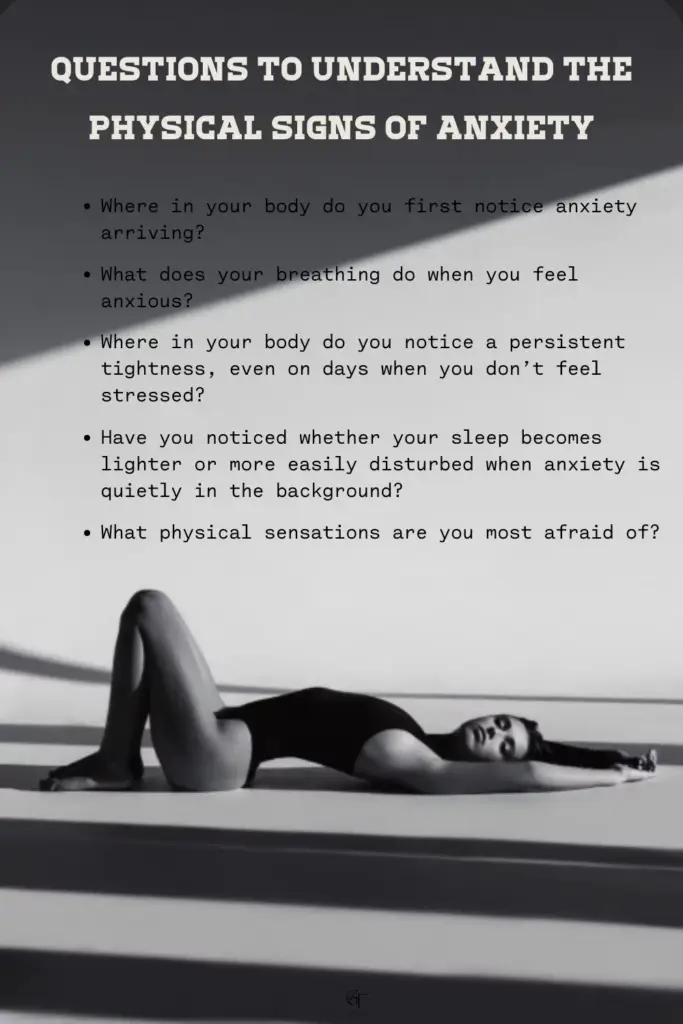
1. Where in your body do you first notice anxiety arriving? The chest? The stomach? A tightening in your throat? Your body often knows before your mind catches up. Start paying attention to the earliest physical signal — that’s your early warning system.
2. What does your breathing do when you feel anxious? Shallow breathing is both a symptom and a driver of anxiety. Understanding your breath pattern gives you one of the most immediate tools for intervention. Research from Harvard Health confirms that diaphragmatic breathing directly activates the parasympathetic nervous system, reducing the stress response.
3. Where in your body do you notice a persistent tightness, even on days when you don’t feel stressed? Chronic muscle tension — especially in the jaw, shoulders, or hips — can be a sign of anxiety that’s become so baseline you’ve stopped noticing it.
4. Have you noticed whether your sleep becomes lighter or more easily disturbed when anxiety is quietly in the background? Difficulty falling asleep, waking at 3am with racing thoughts, or sleeping too much can all be anxiety’s fingerprints. Sleep disruption and anxiety feed each other in a particularly vicious cycle.
5. What physical sensations are you most afraid of? Some people with anxiety develop a fear of their own physical symptoms — the racing heart, the dizziness, the nausea. This is called interoceptive anxiety, and naming it is an important first step.
Section 2: Identifying Your Personal Anxiety Triggers
This is one of the most important sets of questions to ask yourself about anxiety — because until you know what actually sets it off, you’re essentially fighting in the dark.
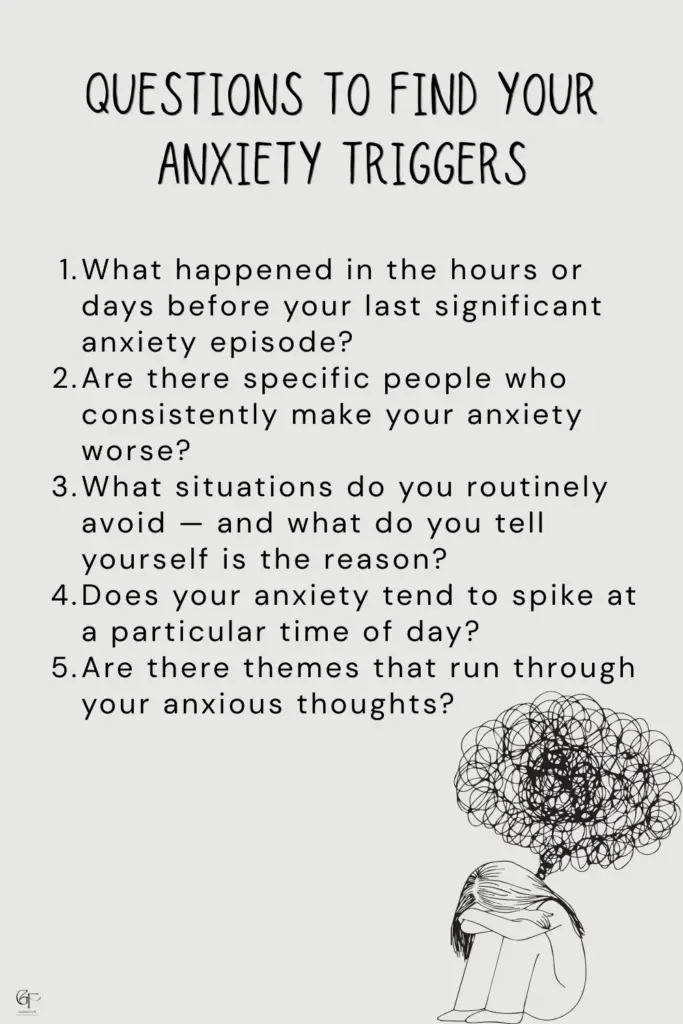
6. What happened in the hours or days before your last significant anxiety episode? Anxiety is rarely as spontaneous as it feels. Look backward. Was there a difficult conversation? A deadline? A piece of news? A night of poor sleep?
7. Are there specific people who consistently make your anxiety worse? Not because they’re bad people, necessarily — but because something in the dynamic triggers an old pattern. It might be about power, criticism, abandonment, or feeling unseen.
8. What situations do you routinely avoid — and what do you tell yourself is the reason? This is a big one. Avoidance is one of anxiety’s most effective disguises. We often have very convincing rational explanations for why we simply don’t go to parties, don’t apply for promotions, don’t make phone calls. What’s underneath those explanations?
9. Does your anxiety tend to spike at a particular time of day? Morning anxiety (before the day has even begun) often points to anticipatory fear. Evening anxiety frequently relates to rumination. Noticing the timing pattern can help you understand the function.
10. Are there themes that run through your anxious thoughts? Health, rejection, failure, loss of control, abandonment, embarrassment? Most people’s anxiety clusters around two or three core themes. Identifying yours is enormously clarifying.
Section 3: Exploring the Stories Anxiety Tells You
Anxiety is a storyteller — and it’s not a reliable narrator. Learning to identify the narratives your anxiety constructs (and question them) is one of the most powerful things you can do.
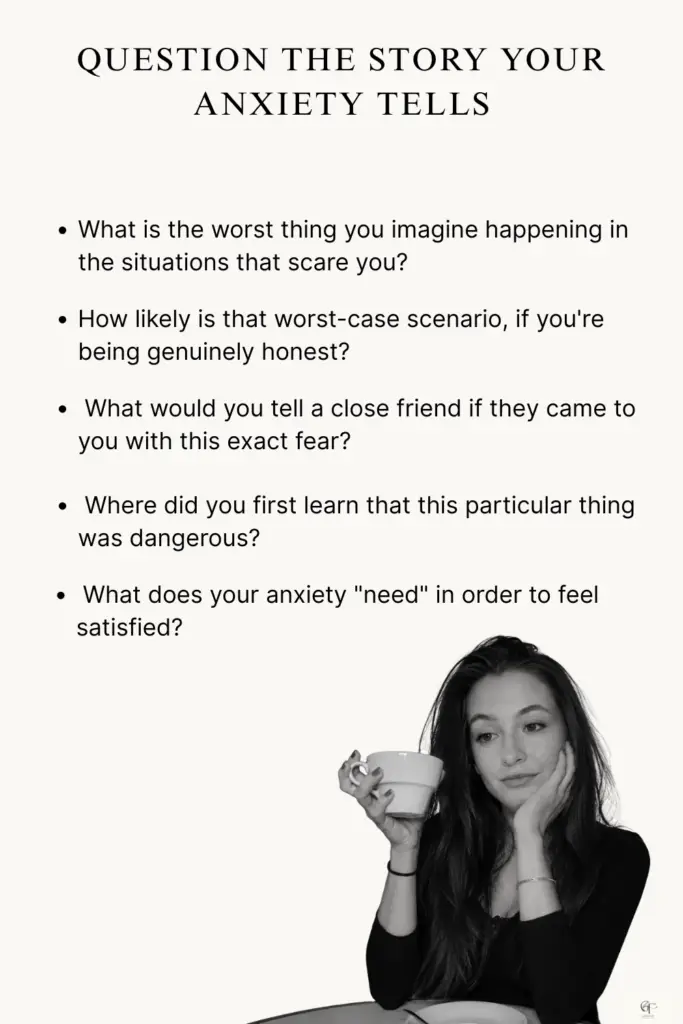
11. What is the worst thing you imagine happening in the situations that scare you? Say it out loud. Write it down. Often the catastrophe we’ve been bracing for is something we’ve never actually examined clearly — and externalizing it reduces its power.
12. How likely is that worst-case scenario, if you’re being genuinely honest? Anxiety inflates probability. A useful question from Cognitive Behavioral Therapy frameworks is: “What’s the evidence for and against this belief?”
13. What would you tell a close friend if they came to you with this exact fear? We are almost always kinder and more rational with others than we are with ourselves. The gap between your self-talk and what you’d say to a friend is worth examining closely.
14. Where did you first learn that this particular thing was dangerous? Anxiety has roots. Fear of judgment, for example, usually didn’t arrive from nowhere — it was taught, often in childhood. Who modeled it? What experiences reinforced it?
15. What does your anxiety “need” in order to feel satisfied? More reassurance? More certainty? More control? Anxiety tends to have a preferred flavor of relief — and understanding that craving helps you see why the relief is always temporary.
Section 4: Looking at Patterns Over Time
Anxiety isn’t usually a single problem — it’s a pattern. And patterns have histories.
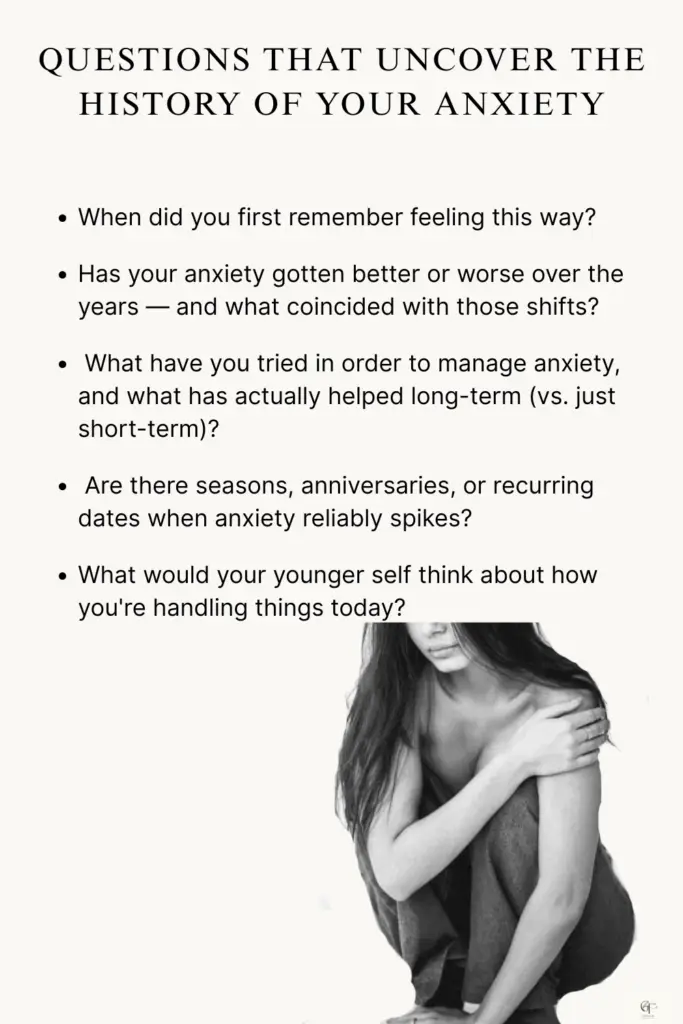
16. When did you first remember feeling this way? Not necessarily your first ever anxiety, but the feeling you’re experiencing now. Does it feel familiar in a way that goes further back than you might expect?
17. Has your anxiety gotten better or worse over the years — and what coincided with those shifts? Life changes, relationships, losses, successes — anxiety often tracks our major life transitions. What was happening when it intensified?
18. What have you tried in order to manage anxiety, and what has actually helped long-term (vs. just short-term)? This question helps you separate coping strategies from avoidance strategies. Short-term relief isn’t always the same as healing.
19. Are there seasons, anniversaries, or recurring dates when anxiety reliably spikes? The body keeps a calendar. Anxiety often peaks around dates that hold emotional weight — anniversaries of loss, holidays with complicated histories, the anniversary of a difficult period.
20. What would your younger self think about how you’re handling things today? This question isn’t about judgment — it’s about compassion. It can also reveal how far you’ve come, which we often forget to acknowledge.
Section 5: Understanding Your Relationship with Control and Safety
Much of anxiety, at its core, is about trying to control the uncontrollable. These questions dig into your relationship with uncertainty.
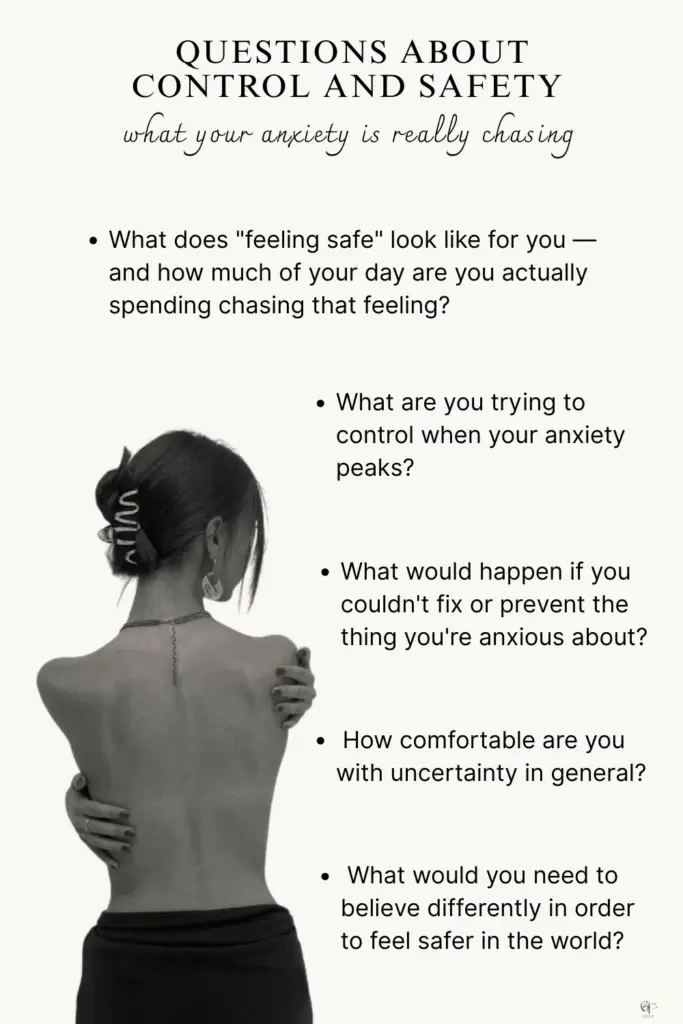
21. What does “feeling safe” look like for you — and how much of your day are you actually spending chasing that feeling? For many anxious people, safety is a constantly moving target. Understanding how much mental energy goes into seeking safety is often a revelation.
22. What are you trying to control when your anxiety peaks? Other people’s reactions? The future? Your own body? Outcomes? The answer usually points toward a core fear worth exploring.
23. What would happen if you couldn’t fix or prevent the thing you’re anxious about? Sitting with this question — really sitting with it — often reveals a deeper fear underneath the surface one.
24. How comfortable are you with uncertainty in general? Research consistently shows that intolerance of uncertainty is one of the strongest predictors of anxiety. On a scale from “totally fine” to “unbearable,” where does not-knowing tend to land for you?
25. What would you need to believe differently in order to feel safer in the world? This is a more hopeful version of the control question — it points toward what might need to shift, rather than just what’s wrong.
Section 6: Moving Forward With Clarity
These final questions are about understanding what anxiety might be asking of you — what it might actually be trying to protect.
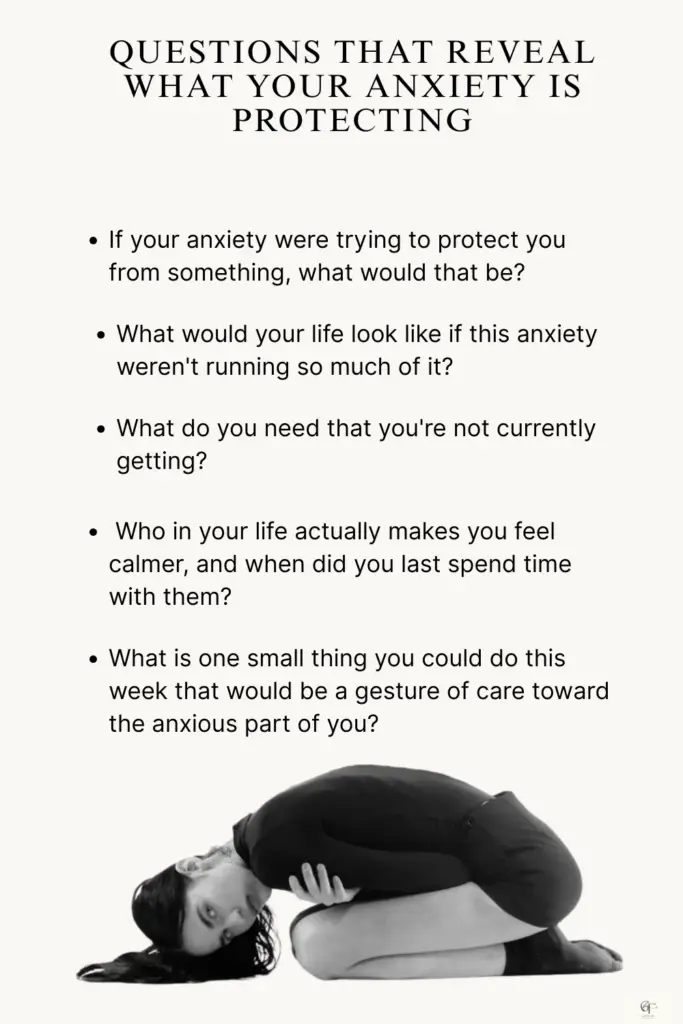
26. If your anxiety were trying to protect you from something, what would that be? Anxiety is almost always protective in origin, even when it’s maladaptive in practice. What is it guarding?
27. What would your life look like if this anxiety weren’t running so much of it? Not “if anxiety were gone” — but if it weren’t driving the car. What decisions would you make? What would you do or say or pursue?
28. What do you need that you’re not currently getting? Often, persistent anxiety is a signal of unmet needs — for safety, connection, recognition, rest, or meaning. Naming the need is the first step toward meeting it.
29. Who in your life actually makes you feel calmer, and when did you last spend time with them? Co-regulation — the way our nervous systems settle in the presence of safe people — is real and powerful. Who are your people?
30. What is one small thing you could do this week that would be a gesture of care toward the anxious part of you? Not a cure. Not a fix. Just one small act of kindness toward yourself. Sometimes that’s where healing starts.
Quick Reference: 30 Essential Questions to Ask Yourself About Anxiety
Physical Experience: Where does anxiety live in your body? How does your breathing change? Where do you hold chronic tension? How does sleep shift? What physical sensations scare you most?
Triggers: What happened before your last episode? Which people spike your anxiety? What do you avoid and why? When during the day does it peak? What themes run through anxious thoughts?
Anxiety’s Stories: What’s the worst-case scenario? How likely is it, really? What would you tell a friend? Where did this fear originate? What does your anxiety need to feel satisfied?
Patterns Over Time: When did this first feel familiar? What coincided with shifts in intensity? What’s helped long-term vs. short-term? Are there seasonal spikes? What would your younger self think?
Control and Safety: What does feeling safe look like for you? What are you trying to control? What would happen if you couldn’t fix it? How do you handle uncertainty? What would you need to believe differently?
Moving Forward: What is anxiety protecting you from? What would life look like without it driving? What unmet need might be underneath? Who makes you feel calmer? What one small act of care can you offer yourself this week?
A Closing Thought
Anxiety is exhausting, isolating, and often deeply confusing. But it is not random, and it is not permanent, and it is not the truest thing about you.
These 30 questions to ask yourself about anxiety won’t resolve everything in one afternoon. Some of them will open doors to things that need more than a journaling session — things that might benefit from a good therapist, a trusted friend, or a supportive community. If you find yourself hitting something that feels too large to hold alone, please reach out. The Anxiety and Depression Association of America has resources for finding professional support.
What these questions can do is start the process of turning toward your anxiety instead of away from it. And in my experience — both personal and in watching others do this work — that turn is where everything begins to shift.
Did any of these questions hit differently for you? Drop it in the comments — you might be giving someone else exactly the language they needed.
Save this to Pinterest so you have it for the next time anxiety feels bigger than you can manage.
And if you want more honest, practical writing on mental health, anxiety, and learning to feel like yourself again — subscribe below. No fluff. No toxic positivity. Just real talk.
If you found these questions helpful, you may also enjoy my previous article, “8 Science-Backed Anxiety Relief Methods Therapists Actually Use.“ It covers practical, research-backed techniques to help calm anxiety and feel more in control.