What Is Soft Productivity?
If your to-do list makes your chest tight before you’ve even opened your laptop, you’re not lazy. You’re tired of a system that was never built for how humans actually function.
Soft productivity is a gentler way of getting things done — one that works with your energy and nervous system instead of against them. Rather than chasing output at any cost, it asks a quieter question: what can I do today that feels sustainable, not just impressive?
By the end of this post, you’ll have seven concrete, low-pressure ways to bring soft productivity into your own routine — starting tomorrow morning, not “someday.”

My Story: How Hustle Culture Wore Me Down
For years, my mornings started with a mental scoreboard. Before I’d even had coffee, I was already tallying what I hadn’t done yet.
I used to treat every day like a performance review, and every evening I fell asleep replaying the tasks I’d left unfinished instead of the ones I’d completed. It wasn’t discipline. It was anxiety wearing a productivity costume.
The shift didn’t come from doing more. It came from learning to notice when my body was signaling “enough,” and building my days around that signal instead of ignoring it.
Soft Productivity vs. Hustle Culture
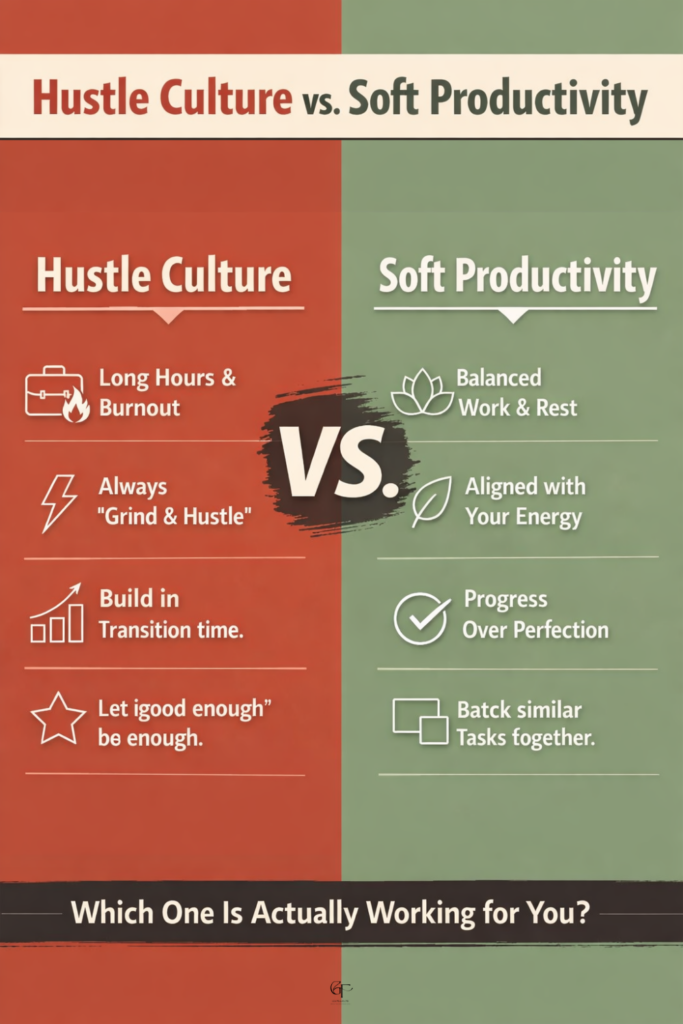
Hustle culture measures your worth by your output. Soft productivity measures success by whether your pace is something you can actually sustain.
This is where gentle productivity and slow productivity overlap with soft productivity — all three reject the idea that busyness equals value. They share a core belief: your nervous system isn’t an obstacle to your goals, it’s the thing making your goals possible in the first place.
Research on chronic stress backs this up. When your body stays in a prolonged stress response, it affects concentration, memory, and decision-making — the exact skills hustle culture demands you use more of, not less (American Psychological Association).
If these symptoms feel familiar, it’s worth looking into the signs of high‑functioning burnout — many people operate at a high pace for years without realizing how exhausted their nervous system actually is.
How to Practice Soft Productivity: 7 Gentle Shifts
1. Start With a “Minimum Viable Day”
Instead of writing a to-do list you’d need twelve hours to finish, ask: what are the one to three things that would make today feel okay, even if nothing else gets done? Everything past that is a bonus, not a requirement.
This one shift alone tends to lower the background hum of guilt that comes from an unrealistic list. You’re no longer measuring the day against everything you could theoretically do — just against the few things that genuinely matter.
2. Work With Your Energy, Not the Clock
Notice when your focus is naturally sharpest — morning, midday, evening — and protect that window for your most demanding task. Save low-energy hours for small, low-stakes tasks like replying to emails or tidying your space.
Traditional productivity advice treats every hour as interchangeable, but your body doesn’t work that way. Pay attention for a week and you’ll likely spot a pattern — most people have one or two windows a day where focus comes more easily.
3. Build In Transition Time
Jumping straight from one task to the next keeps your body in low-grade alert mode. A two-minute pause between tasks — stretching, looking out a window, taking a few slow breaths — gives your nervous system a chance to reset before the next demand lands.
It can feel unproductive at first, almost like you’re “wasting” time. In practice, it usually means you arrive at the next task with more focus, not less.
4. Let “Good Enough” Be Enough
Perfectionism is exhausting because it has no finish line. Practicing slow productivity means deciding in advance what “done” looks like for a task, so you’re not chasing an invisible, ever-moving target.
Try naming the finish line before you start: “done” might mean the email is sent, not that it’s been reread five times. Deciding this up front takes the decision out of the moment you’re already tired.
5. Batch Similar Tasks Together
Constantly switching between different types of tasks — a phone call, then deep writing, then a quick errand — taxes your attention more than the tasks themselves. Grouping similar tasks reduces the mental cost of switching gears.
Try setting aside one block for anything communication-related — emails, calls, messages — and a separate block for focused work. You’ll likely notice both feel easier when they’re not constantly interrupting each other.
6. Protect One Non-Negotiable Rest Point
This can be a lunch break away from your desk, a short walk, or ten minutes with no screen. The point isn’t the activity — it’s giving your body proof, daily, that rest is allowed before you’re depleted, not just after.
Think of it less as a reward for finishing your list and more as a fixed part of the day, the same way a meeting would be. Over time, this is what teaches your nervous system that rest doesn’t have to be earned.
7. Track Effort, Not Just Output
At the end of the day, note what you tried, not only what you finished. This keeps your sense of progress attached to something you actually control, instead of results that depend on factors outside your hands.
A simple line at the end of the day — “today I showed up for X” — can do more for long-term motivation than a checklist that only counts what got fully finished.
What Nervous System Friendly Productivity Looks Like Day to Day
Nervous system friendly productivity isn’t a rigid system — it’s a set of check-ins. Before adding something to your day, you might ask: does this feel like pressure or like purpose? Both can get things done, but only one is sustainable long-term.
Mindfulness-based approaches, including simple breathing practices, have been shown to help regulate the body’s stress response, which is part of why so many soft productivity routines include a grounding practice before diving into work (Mayo Clinic).
Small, repeatable rituals — like reviewing your day with kindness instead of criticism — do more for long-term consistency than any single productivity hack.
In practice, this might look like a two-minute check-in before you open your laptop: noticing your energy level, naming one thing you’re looking forward to, and choosing your first task based on that, rather than whatever feels most urgent. It’s a small habit, but it sets the tone for how the rest of the day feels — task by task, rather than as one long undifferentiated push.

Quick Recap: Soft Productivity Tips
- Set a minimum viable day instead of an all-or-nothing list
- Match tasks to your natural energy windows
- Add short transitions between tasks
- Let “good enough” close the loop on perfectionism
- Batch similar tasks to reduce mental switching costs
- Protect one daily rest point before you’re depleted
- Track effort, not only finished output
FAQ
What is soft productivity? Soft productivity is an approach to getting things done that prioritizes sustainability and nervous system regulation over constant output. It focuses on working with your natural energy and capacity rather than forcing yourself through burnout.
How is soft productivity different from regular productivity advice? Traditional productivity advice often assumes unlimited energy and willpower. Soft productivity assumes the opposite — that energy is limited and fluctuates — and builds routines around that reality instead of ignoring it.
Is soft productivity the same as slow productivity? They overlap closely. Both reject hustle culture, but slow productivity leans more into pacing and fewer commitments, while soft productivity puts extra emphasis on emotional and nervous system regulation as part of getting things done.
Can soft productivity actually help with burnout recovery? Yes. Because it reduces the constant stress-response cycle that hustle culture reinforces, soft productivity can be a helpful part of burnout recovery — though it works best alongside rest, boundaries, and professional support if burnout is severe (NIMH).
Where do I start if hustle culture feels like the only thing I know? Start with just one shift — like defining a minimum viable day — rather than overhauling your whole routine at once. Small, consistent changes are more sustainable than a complete reset.
Final Thoughts
Soft productivity isn’t about doing less for the sake of doing less. It’s about building a pace your nervous system can actually sustain, so the things you care about don’t cost you your wellbeing to achieve.
You don’t need a new planner or a perfect system to start. You need one small shift, tried consistently, starting with whatever feels most doable today. Progress that lasts is built this way — one gentle, repeatable step at a time.
Give yourself permission to measure success differently — not by how much you crossed off, but by how you felt while doing it. Over weeks, these small, sustainable choices add up to something hustle culture never delivered: a way of working you can actually keep doing, day after day, without burning out.
Your Turn
Which of these seven shifts feels most doable for you this week? Save this post to Pinterest so you can come back to it, and drop a comment below with the one you’re trying first.